My Queen's Saga: The Inside Story in 25 Emails.
SBs voice and the audience came from his position as Head Coach at Queen's. To think of a different scenario, imagine a senior member of the advancement department ripping apart a sister university for there (sic) acceptance of a gift, and then blaming the employees and possibly other donors for their culpability in this. This would be a one and done event!
-Tom Harris, Queen's Provost, Feb 20, 2020.
It's very late January of 2020 and somewhere in the administrative offices of the University of Guelph a group of staff is scheduling 8 hours of "strategic planning". As the email below seems to suggest, the subject of this planning activity will be the university's response to an impending scandal of national scale. The Globe and Mail has been investigating and will soon publish -- in painstaking detail, it would turn out, and with full, weekend edition front page treatment-- a 13 year long tale of sexual exploitation and abuse, featuring long time (and recently fired) Head Guelph cross country and track coach Dave Scott-Thomas, and including the voices of a dozen or more Guelph XC/Track alumni.

But informal discussion of and rumours about an impending scandal at Guelph-- mostly anonymous, but not necessarily uninformed-- had been proceeding for weeks, and in great volume, on fan social media sites like (Letsrun.com and Trackie.ca), where subject matter of this kind is always of very keen interest. Interest in this particular story, however, was propelled by the fact that the program at Guelph-- despite, and to some extent because of, its record of competitive success-- had been the target of accusations of unethical behaviour in the past, from the relatively minor to the more serious, and because rumours of a dark secret about Head Coach Dave Scott-Thomas had been widely circulating within the Canadian sport community for at least a decdade. There was a pervasive sense that, this time, something much bigger might be about to break.
I had been an active participant in some of these these discussions, because-- having been on the receiving end of unethical behaviour on the part of Scott-Thomas and at least one of his close colleagues, having detailed information on other petty abuses, and having been at one time fed the lie that ended up becoming central to the Globe's exposè-- I was eager to make the case that the behaviour Scott-Thomas was about to be very publicly accused of was part of a larger pattern-- one that had, I felt, been hiding in plain sight for many years. I was also at pains to make the case that Scott-Thomas' long time impunity had to have been, at least to some extent, and in relation to some of his abuses, a collaborative effort. I wanted to make it clear, in other words, that the apparent inability of those who worked most closely with Scott-Thomas over the years to see what some others could see so clearly had to have been willfull-- not least because most of these behaviours were done to benefit the program as a whole and not simply Scott-Thomas personally. Aside from the worst of what he was suspected and accused of (the sexual exploitation of a very young Megan Brown), everything he had done, including the breaches of ethics I had personally been on the recieving end of, and had documented contemporaneously, had all been calculated and systematic in nature-- they had not been the results of momentary lapses in personal judgement. Scott-Thomas was eventually revealed to be person who was inclined to simply take what he wanted when he wanted it and aggressively deny culpability if and when challenged. What he sought through his sexual exploitation of a young athlete was obvious and purely personal. His other unethhical behaviour was driven by his cynical understanding of the requirements of "program building". What he wanted-- and took-- through his more routinely transgressive behavior was team titles and other coaching successes that would build his stature and power within the sport at both the university and club levels-- successes that would also benefit many of the others with whom he worked, including athletes, staff, and university/club stakeholders. And, for almost 20 years, his efforts had largely been successful. He and his programs had won enough titles and enjoyed enough individual success that it became, by about 2012, possible to dismiss any criticism of his behaviour by colleagues or "expendable" athletes as professional jealousy and/or the whining of those who "didn't have it".
As details of the scandal began to leak in late 2019, I had no idea how others might react or what they might say, but I wanted to make sure that there was at least one voice (and a real one, willing to go on the record) demanding accountability-- not just from the lone "bad man", but from those who had clearly enabled him by commission or omission, and for their own partial benefit, starting with the University of Guelph itself, whose failure to fire him in 2006 made everything thereafter possible. For the sake of the sport community as a whole, what Scott-Thomas had done could not be allowed to stand as an example of how to pursue "high performance"-- in the university system or anywhere else.
And as elements of the story leaked, it became clear from social media discussions that many interested parties were coming to the same rather obvious conclusions I was. But I was all but alone in speaking openly and under my own name, as I always did. And of the few who were willing to raise questions openly, I knew I was probably the most vulnerable to retribution from both Guelph and Queen's. There was never a question of legal liability from individuals, because all I was doing was attempting to focus the broader public discussion on what I deemed to be the right questions. Instead, I was in danger of becoming a problem for the "communications strategy" of Guelph (to which Queen's would soon offer to contribute), thus opening myself up to informal censure and perhaps worse.
And so it came to be that member of Guelph's "strategic planning committee" chose to send the email pictured above to my boss, Queen's Athletic Director Leslie Dal Cin, whom the sender addressed in terms suggesting personal familiarity ("Hi Leslie"), asking is no uncertain terms for help in-- and there is really no other way to put this-- silencing my online commentaries on the scandal whose fallout they were preparing to manage. Below, for reference, is the Trackie.ca message post that was attached to the email. I made this post in reponse to the official media confirmation that Dave Scott Thomas had indeed-- as per the anonymous message board rumours that had been circulating since at least December-- been under suspension from his position since the previous September, pending an investigation into possible sexual impropriety in the line of duty. The questions I raised were, again, completely straightforward, but included no personal accusations whatsoever. Any potentially guilty parties would have known exactly who they were in any case. And note that my tone, use of language, or "target" were not at issue in any way at this point. There were no vulnerable "undergraduates" deemed to be in danger of my "berating and bullying". What was clearly at issue was the fact that I was speaking out at all. Without any apparent hesistation, and seemingly without knowlege of or concern for Queen's robust public statement affirming the right to free speech of all community members ,up to and including the right to speak in ways deemed "disturbing", Queen's Athletic Director Dal Cin promises "expeditious" action to honour the Guelph request, offers her professional sympathies, and even promises a personal call to confirm completion of the request. If she had even a moment of concern for her obligations to anything beyond the needs of a colleague in a difficult situation it was never apparent in these email exchanges.
 I was duly contacted by email, told my contributions to the discussion of the Dave Scott-Thomas scandal were "highly inappropriate", and threatened with disciplinary action should I continue to comment. My invocation of my right to speak freely on the subject was gainsaid by the simple reminder that I was a Queen's coach and thus subject to departmental communications policies "at all times". For her, there was no option of speaking in any non-official capacity as long as she, acting for Queen's, deemed the university to have interests and concerns at stake.
I've often wondered what might have been had Director Dal Cin at any point taken seriously Queen's quite bold public committment to free speech; or, if she had stopped to consider that, perhaps, Guelph actually had this scandal coming to it; that people, especially long time members of the sport community like me, were bound to talk about it; and, that Guelph representatives should not be seeking to enlist other university administrations in its public relations counter-mobilization. Might she have said something like: "While we with sympathize with your situation at the moment, our faculty, staff, students, and visitors are formally entitled to speak freely on matters of public interest (link to statement). However, if you believe anything Coach Boyd has said is legally actionable, we urge you to exercise your rights in that regard". Or might she have just offered the standard, "Coach Boyd's opinions are his own and do not represent those of Queen's University."?
(And, more on this shortly, but it should be clear to anyone by this early point that Queen's was fully prepared to fire me for further commentary of ANY kind on this issue-- or at least any further critical commentary. They would ultimately-- and infamously, given the complete lack of concrete evidence ever adduced-- claim that I was fired for a long history of "offensive public commentaries" involving the abuse of "undergraduates". But it was made abundantly clear to me at this opening stage-- as it would have been to anyone-- that it would be a firing offense for me to say anything more on the matter than, perhaps, "leave Guelph alone!").
As it happened, the Queen's/Guelph scandal-management partnership was only beginning. On February 8, the Globe and Mail would explode its bombshell, raining weeks of fallout across the sport community and consuming 100s of highly paid person-hours across both administrations. As I'll demonstrate below with further recovered emails, most of Queen's admin's time was spent trying to concoct a defense for the decision to fire me at Guelph admin's request and amid a "fire storm" (Provost Harris' eventual words) of complaints from Queen's alum and other interested parties, including many safe sport and free speech defenders and advocates. In retropect, I suppose I should have been flattered that both institutions seemed to fear the things I had to say and the questions I was raising, but that would be giving them far too much credit. They were desperate and I was simply an easy target; a cost-free way of experiencing at least a moment of control in an otherwise out-of-control public relations meltdown.
On February 12, four days after the initial Globe article but many weeks after author Michael Doyle had begun interviewing members of the Guelph XC/Track community, including alums like her, Robyn Mildren would make a public post on her Facebook page, reflecting on the scandal and lamenting how the perhaps misplaced (she thought) priorities of team members over the years had lead to their mutual failure to better protect one another from some of the abuse described in the piece. But, somewhat ironically, I thought, she also took time to celebrate in words and pictures the program's many years of competitive success under coach Scott-Thomas and his staff, forgetting that it was he and his staff who had assembled and deployed them in pursuit of team success in the first place, systematically using some of the abuse she decried precisely in order to gain the competitive advantage that would help enable such success. Those who are still unfamiliar with this post and ensuing discussion can refer to the blog post immediately below this one.
My response to Mildren's message was simple: I asked her what sanctions she thought should be brought to bear against the university of Guelph for its manifest failure to protect its student athletes from risk at the hands of an abusive Head Coach. I avered that sanctions should be focused on the XC and Track programs themselves, since any failure of duty could reasonably be explained in terms of a desire to protect the value of the asset that Dave Scott Thomas and his successful program represented to the university. And in response to the objection that such punishment would fall unfairly on athletes themselves, I offered that this was indeed inevitable but not neccessarily unfair in every instance. After all, I argued, it takes a whole program,including athletes in senior leadership positions (who are, I pointed out, almost universally legal adults in university programs), to create both great AND abusive programs; that creating ANY kind of "culture", good or bad, was a collective endeavour, requiring leadership at all levels, including that of student-athletes themselves. I did not directly name any athletes or other program leaders at Guelph. The gist of what I argued was simply this: That you can't take collective credit for the creation and maintenance of a positive team culture if you're not willing to assume similar responsibility for a bad-- even abusive-- team culture. And Guelph XC/Track had never been shy about celebrating the genuinely positive aspects of its team culture-- particularly the winning aspect, which Mildren was doing even in the context of the abuse scandal itself. It just did not seem capable at this point-- nor really since-- of coming to grips with its collective responsbility for failing to prevent or address the truly bad aspects.
And it should be noted once again that this discussion took place initially between those whom Facebook's inscrutable algorithm notified of Mildren's post. Its contents were not "in the media" in any way. I, personally, had very rarely ever seen a post, public or private, from the page of a University of Guelph athlete, current or former. For some reason, I was to see this one. It should be further noted that Mildren could have blocked me from posting after my first question. For reasons known only to her, she did not, nor did she choose to remove her post or change its status to private. She let the discussion continue, and it remains public as of this writing. And for all the shrill reaction to my participation in this thread, I was permitted to continue till the end. And, if you check the record, you'll see that the reaction to my questions and comments was not even uniformly negative. In what followed in the days after, I was often presented as having forced my ideas and opinions onto a still emotionally raw and unwilling audience, rather than simply offering them first to Robyn and then to whomever might happen onto the discussion. And, judging from those who participated actively or by "liking" comments, those who happened along were predominantly alumni in their late twenties to early 40s, with an average age of 30-something, many of whom had no doubt been interviewed for the Globe's exposè weeks prior, and who had had years to process their experiences-- good and bad-- as Guelph athletes.
As the email message below indicates, none of this stopped at least one representative of Guelph admin from making the shift from politely asking for Queen's' support in shutting me up to demanding action to stop me; accusatorily, and in bold, underlined font. Nor did it stop a very senior Guelph non-athletics admin from making entreaties to her Queen's counterpart (replete with almost certainly false-- and irrelevant even if true-- rumours about a heckling of current Guelph track athletes at a meet in Windsor the weekend before, and her fear that Queen's athletes-- all 6 of them, versus Guelph's 60-odd-- would pose some kind of threat to Guelph athletes at the upcoming OUA meet in Toronto!
Note in the first email that the CEO and Head Coach of Athletics Canada are now cc'd, making it clear that Guelph admin's target is no longer simply my coaching job at Queen's; it is my status as a coach, period. (In a subsequent email reply, Athletics Canada legal council informs the sender that its complaint against me is not actionable, adding that in the cases of both my Trackie and Facebook comments, simple remedies were available in the form of the "report post" and "block" options respectively. This is why you will have not heard of any disciplinary action having been taken against me by Athletics Canada-- which,incidentally, it would have had a lot of nerve doing, considering its own flaming complicity in failing to deal appropriately with Dave Scott Thomas many years before.


I have not even bothered to include Queen's Vice-Provost Anne Tierney's reply-- which was, as you would expect by now, sympathetic, credulous, and accepting in full of the request.
But I simply can't resist including this unrelated and contemporaneous email, courtesy of plodding High Performance Director Sean Scott, who felt the need to send the following three line note (with attached photos copied from Instagram) to Director Dal Cin on February 18, the very day the decision was made to terminate me. A handful of Queen's athletes had travelled to complete in Boston on Feb 14/15, entered and fully funded by their (my) club in order to avoid the administrative difficulty and expense of competing for Queen's that weekend-- something which is fully permitted and common within both the OUA and U-Sports leagues. Because they did not own club singlets, and because their Queen's singlets were high tech and comfortable, they chose to wear them while racing-- something that was in no way prohibted by rules of any kind, including those of the meet itself. But Director Scott, who had for a whole term in 2018, actively ignored the entire Queen's XC team in a fit of pique, and who had that year "forgotten" to include my OUA Coach of the Year recognition in the Queen's Athletics Awards Night program (something for which the entire Queen's Athletics Department admin was forced to publicly, and in writing, apologize) could not resist a final, tiny, and pointless bullet in the metaphorical corpse of me and my program. Of particular note is his use of the word "also"-- meaning in addition to my having been fired!

According to the email records I was able to obtain, and from which the preceding have been selected, I counted, all told, three complaints against me, including the two above, which clearly have their origins in Geulph admin (one is completely unredacted, as you can see). As for the third, its impossible to even guess at the origin. In the couple of weeks or so that followed, there would be five messages in support of my firing (one of which is reproduced further below), three of them very brief, and two comprised of completely unhinged ravings. This is against dozens of long form, often eloquent, and sometime poignant letters of support, usually from alumni, but often from just members of the sport and larger communities.
Queen's had, of course, prepared a set of boilerplate talking points in the hours between the decision to terminate me and the official annoucement. But the publication of prominently placed article on my dismissal in the Globe on Feb 19 , the day before the OUA indoor track championships, clearly created complications for their PR defense plan*. So too did the fact that the person who would take responsbility for the firing (Provost Tom Harris, whose final week on the job would begin in 4 days) still seemed to require briefing on why he himself made the decision! The reaction of the team and its resolve to get to the bottom of the story (led by the estimable captaincy group of Miles Brackenbury, Rob Kanko, Marley Beckett, and Kara Blair, whose intelligence, passion, and determination moved and still moves me to this day) also seem to have caught admin somewhat by surprise. Their reaction in the emails below indicates that they still somehow expected threats to their version of events to appear from many angles, including in the form of my further social media output and, possibly, the behaviour of Queen's athletes themselves at the OUA championships (a narrative swallowed whole from the Guelph Vice Provost's letter above).
*Lost in the extensive redactions and reason for speculation to this day is the reason why Queen's gave itself so little time to get rid of me, and chose to do it at such an awkward time for all concerned (i.e. the precise middle of the spring Reading Week and two days before a provincial championship). Two possibilities immediately suggest themselves: 1. That they were so afraid of further "public commentaries" on the Guelph scandal that I might produce, and so afraid of Guelph's reaction to them (which, as you can see above, was becoming nearly apoplectic) that they had to distance themselves from me as soon as possible; or 2. That they were concerned that I might have recourse to the university Ombudsperson, who might be sympathtic to my free speech entitlements under the Queen's statement of principle to that effect, thereby making any future action to get rid of or censor me much more complicated and difficult. I may never know the answer to this question, but it's my hope that one day someone with direct knowledge will decide to end the mystery for me. Or perhaps there is a third possibility: Incompetence and lack of forethought...
In the internal memo below, Queen's admin presents its initial positioning, whose internal and public facing aspects were the same, centering on the assertion that I was guilty of "publicy commentaries" that did not square with a set of unspecified "Queen's Values". It would also attempt to place the entire case inside the legal black box of "HR Issues". Under such cover, it would never specify exactly which "public commentaries" its messaging referred to, nor the specific "values" they supposedly violated, in spite of much pleading, public and private, to adduce these pertinent details. In the case of Queen's XC/Track team members, these were the most important of the facts they would immediately request. They would never learn them.

And even though officially fired and no longer Queen's responsibility, my "public commentaries" were apparently deemed threatening enough to warrant continued monitoring. Threatening enough, in fact, to warrant the deployment of the Associate Vice-Principal of the university (a Brenda Paul), whose official remit was "Internal Communications". In the note below she promises Athletic Director Leslie Dal Cin that she will be "manually tracking" my activity on a "communication channel" (the Trackie message board, as per the email to which she is replying) because it is not picked up by the university's "social listening tool". Yes, Queen's University was prepared to deploy something called a "social listening tool" to monitor the communications of someone who was no longer its employee! This suggests to me that they were perhaps worried that I might actually know more than I had said to up to that point, perhaps even regarding senstive information specific to Queen's itself (info that I did not and do not have, of course).
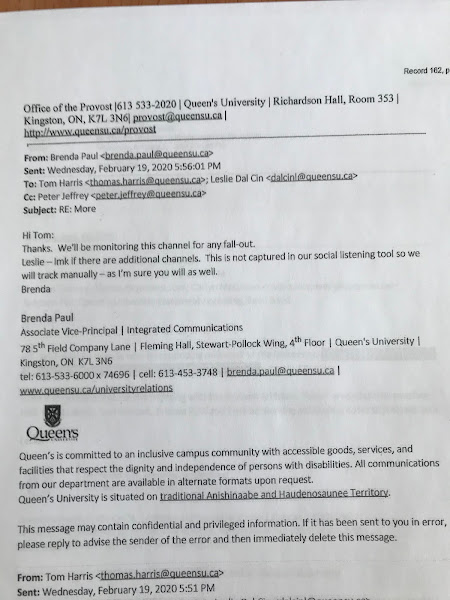
The so-called "fall-out" referenced in the above email is in response to both the orginal Globe article on my firing and a follow-up story the next day. In fact, the phrase ("fall out") is borrowed from the title of the article itself.
There was little unredacted commentary on either of these media stories in the emails I was able to obtain, but the one below reveals Queen's fear of student athletes speaking out on the issue. The student referenced in the emails below is team Captain Marley Beckett, a Second Team All-Canadian and Chancellor's Scholar who would apply to transfer to the University of Bristish Columbia the following month.
And at the bottom of the second email below we see concern for potential problems related to the team's participation in the OUA Track Championships the following day and more paranoia about the threat of further "public commentaries" from me, this time including secondhand information they suspect I might be providing to others (i.e."On Trackie a lot of internal info, so clearly he is providing content somewhere. He has yet to post himself")!


In the two emails below, we see, respectively, acknowledgement that XC/Track athletes are being withheld information about my firing-- but also concern that they can't be allowed to know more, lest they go to the media-- and more acknowledgment and fear of the damage at least one athlete (Marley) speaking to the media had already done (i.e. "...it's much worse they we feared").
And, of course, why did Queen's find it necessary to withhold info regarding my firing from my athletes, or fear that they would divulge it to the media once they had it, if the info in question was indeed related to "public" behaviour (as in the phrase "public commentaries"), and was indeed a legitimate basis for my firing? It seems that the provision of this info, if credible, might have been sufficient to eliminate Queen's entire "fall-out" problem in the first place! The minute my athletes were shown proof that I was the person Queen's claimed I was (and they, like just about everyone less, were obviously unconvinced that what they had already seen-- the message board posts and Facebook discussion-- were valid reasons for my dismissal) they would have stood down from their efforts to reinstate me. Likewise the dozens, later many more, who were writing letters of complaint and signing a petition for my reinstatement. It is clear by this point that Queen's was in the process of abandoning its strategy of blaming my "public commentaries" for their action and resorting to more vague accusations designed to stimulate the imagination of those who might be wondering if there was perhaps "more to the story" (which, of course, they knew there was not)
Also note the references to the need to "brief Tom"-- again, the person who made the decision to fire me days before.


The email pictured below-- one with curiously few redactions, considering its ultimate importance to the case Queen's has been making and will continue to make for firing me-- is perhaps the most important one I was able to access. It is important because it reveals nothing less than the actual, contemporaneous reasoning of the person who would take responsibility for the final decision-- Provost Tom Harris.
And, in fact, it is in this message that he reveals himself as the person in question. In internal briefing notes I include a little further below, you will note that Queen's acknowledges the athletes' keen desire to know who exactly made the decision to fire me. Queen's never provided them with this simple bit for information, because the person in question was clearly unprepared to handle athletes' questions or to tell the truth about why he had authorized such a thorough disruption of their lives.)

In case it isn't clear through the highschool-level syntax, here is what Provost Harris is saying:
1. That he has discerned the cut of my jib from a perusual of my posts on Trackie.ca (2600-odd of them over an 11 year period)-- something which he would have had only a handful of hours in which to do between the Facebook discussion and the decision to fire me. He allows that I am believed by the other contributors to Trackie.ca to be a technically competent coach (with the phrase in qualifying quotations marks, for some reason). That I had actually been named U-Sports Women's Coach of the Year that very season, and that our program had consistently been among Queen's very best, arguably the best, for a number of years had apparently not appeared in his "research" on me.
2.That I am a "polarizing figure" on Trackie.ca, and that this registers in the negatives column against my possible "technical competence" as a coach. And bear in mind that the participants on the Trackie.ca message board are more than 90% unregistered and anonymous, which would be obvious to anyone within 5 mins of visiting. Even if being "polarizing" were necessarily a negative attribute (Colin Kaepernick, e.g., is quite "polarizing") , this would be impossible to accurately determine strickly from message board posts on a site like Trackie.ca, which does not require registration and is/was seriously stretched when it came to effective moderation. In my case, with four decades of heavy involvement in the sport, there would have been far more reliable ways to gauge my reputation in my sport community. Indeed, one such way had appearing in his inbox on a daily basis, in the form of letters of support from actual persons-- persons prepared to put their names to a page.
3. That any authority I had to speak about matters of interest in my sport community derived from my status as Queen's coach, and that taking away my position would-- appropriately, he thought-- remove any platform I might have to continue to do this. Again, missing from his research was the fact that I had been involved in the sport for 40 years (30 before becoming Queen's coach), enjoying competitive success from the high school to the masters levels, and coaching success within the club ranks for nearly 20 years. My position as Queen's coach did not afford me any special platform from which to air my opinions-- quite the opposite, in fact. It made me more vulnerable to my most cowardly critics, because any complaint they might want to make against me, for any reason, personal or political, would be be taken at face value by Queen's Athletics Admin. I was always aware that I participated in social media under my own name at some risk to my position at Queen's. The only alternative was a form of self-censorship, and an abdication of any resonsibility to share my ideas and opinions as a very senior member of my sport community.
4.That commenting on Guelph's apparent failure to protect its student athletes from an abusive coach is analogous to "ripping apart a sister university" over something like an ethically questionable financial gift. It is alarming enough that Harris would immediately fire an employee for questioning the ethics of an university advancement program that would accept money from, say, an organized criminal or corrupt politician; its another thing to equate an indirect offence such as taking a questionable financial gift with the very immediate one of failing to protect members of the student body from abuse, and then seeking to cover up that failure. Finally, of course, the simple raising of critical question hardly amounts to the "ripping apart" of the object of these questions, however these question might be posed. But of course what Harris is really saying here is that it is fine to have fired me for speaking critically about Guelph, regardless of the substance of my criticisms, and without warning("one and done", as he says). Once again, we see a university official-- this time an extremely senior one-- appearing to be all but oblivious to the very notion of free speech or whistle-blower rights, let alone his own unversity's pretty black-and-white affirmation of the principle of free speech by community members
5. That is was he himself who fired me ("...that I had authorized the course of action") and not, as per Queen's talking points to XC/Track athletes, the whole of "Queen's University".
6. That the decision had to be justified in terms of "certain princples"-- principles that were not immediately obvious or specified, and/or that might have to be concocted. This would be necessary to confront the "firestorm" that he expected would erupt (and that did, in fact, erupt) when the decision was announced.
But, perhaps more importantly, this is what Harris doesn't mention in this comment (and recall that this email was sent a full 2 full days following the official decision to fire me, and possibly up to a week after discussions about what to do with and about me were initially broached): That I needed to be fired because of, as he would put it in a letter to the editor of the Toronto Star 5 days later, a years long "propensity to berate, bully, and shame student athletes online who were themselves victims". It, of course, strains credulity past the breaking point to imagine that I or anyone could have gotten away with even a few days of behaviour so egregious, let alone years of it. Harris has already revealed that simply speaking negatively about Geulph was a "one and done" fireable offence in his view. But now, with the heat very much on Queen's for having violated its own committment to free speech, he felt the need to elucidate the unspecified "certain principles" he refers to in the email, knowing that the violation of some kind of sibling omerta between universities will not be viewed as acceptable grounds for the decision he has taken. He and Queen's admin had completely underestimated the basic intelligence of just about everyone concerned with this line of rationalization, never mind my and my team members inclination to fight back, and they had managed to figure this out at some point between when Harris wrote the email above and when he wrote his letter to the Toronto Star 5 days later.
And as of the moment of submitting his letter to the Toronto Star, Harris had publicly committed all of Queen's administration, up to and including the Principal, to a defensive PR strategy that centred around the wilful assasination of my character-- a strategy that was, of course, weakened by that fact that my firing was initially justified in terms of my allegedly offensive public commentaries, and by the absurdity of the suggestion that anyone at my level of employment could get away with such behaviour for any length of time at all, let alone "years". And if I had truly been "berating, bullying, and shaming" already vicitimized "student athletes" online, and it were public, the evidence would be available for all to see. Indeed, Queen's could have saved its critics the trouble of having to hunt it down themselves by simply linking the alleged evidence in their communcations-- something they could have done without any risk of violating my privacy.
But there are indications that Harris was not acting alone, and that Queen's was preparing-- under increasing pressure from bad publicity and outside complaints-- to shift the narrative from one centred on my "objectional public commentaries" to one based on my alleged privite "bullying, berating, and shaming" of "student athletes". Below is a copy of a letter from the Office of the Principal intended ultimately for members of the university Board of Trustees (yes, amazingly, this business was now commanding attention at the highest levels of Queen's governance) in which the new language is used for the first time, making it clear that Harris' desire to articulate "certain principles" to justify the decision must have been the subject of internal discussion since my firing. I say more about all of this below.

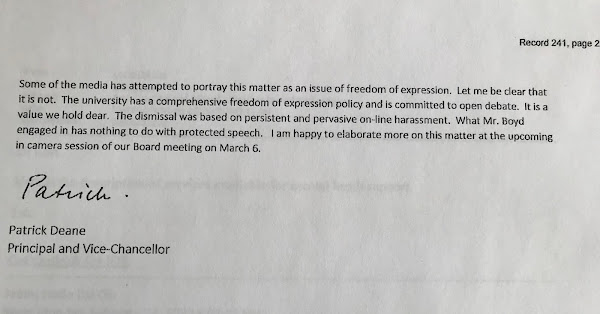
Principal Dean's adamance that my dismissal was not a freedom of speech issue is revealing of the pressure the university was under to offer an explanation that pointed to concerns beyond the obvious and publicly available "commentaries" on the Geulph situation. It was becoming obvious to them that a majority of interested parties did NOT consider the infamous Facebook discussion to include material that would justify the firing of a coach-- particularly one that, they were finding out, had a reputation for offering a program that was the opposite of Guelph's in terms of culture, particularly on the women's side.
And, as it turned out, at least a little of the heat over its decision had been coming from inside the Athletics Department itself, as the following note from Head Football Coach Steve Synder* (dated February 20) clearly shows. And indeed, as you can see, coach Synder hit the nail on the head with his suggestion that having fired me "gives the impression of administrators sticking together" at the expense of accountability!

*Gaps in the redactions to email replies reveal Coach Synder to have been the author of this email.
Evidence of just how badly things were going, and just how desperate they were for some indication that their efforts had been stemming the tide of negative reaction, can be seen below in an email exchange in which adminstrators share relief at finally recieving a note of support from someone who appears to understand my true villainy!


Diretor Dal Cin's fervent hope that the author of this note would get "many more" similarly "kind (and) decent" people who cared about (though didn't mention) the "forgotten" victims in this tragedy to make public statements of support for Queen's was never realized. I could not find evidence that the even the author of this email him/herself had been willing to offer a public statement of support for Queen's-- since there had be no public support anywhere, as far as I could tell.
Meanwhile, below are two samples of the bulk of the messages "the team" Harris refers to had been receiving. Just a day after receipt of that lone message of support, they received the following messages, the first from a representative of something called the Society for Academic Freedom and Scholarship and the second from a concerned alum. I eventually lost track of the number of similar messages I was cc'd on, but I did not see these two at the time they were sent. And note the weary forwarder's introductory message: "Here's another".


There is no indication that Leslie Dal Cin or Queen's ever bothered to respond directly to any of the many messages they had been receiving (in contrast to the immediate and effusive response to that single letter of support). And I know from discussions with many senders of similarly critical messages that, if there was a reply at all, the response was a boilerplate statement of the university's official position. Alumni deemed to be financially valuable to Queen's may have received private communications, but I was not aware of any XC/Track Alumni recieving any form of direct response.
But Queen's admin could not ignore its own student athletes, who were still demanding, at the very least, some explanation of why their coach had been summarily fired, and, at the most, my immediate reinstatement. As my records indicate, from February 21 onward, Queen's admin had been planning in earnest for a promised meeting between XC/Track team members and Provost Tom Harris set for the following week. Additional planning efforts-- including the "briefing" of Tom Harris, the person whom we now know made the final decision to fire me-- was necessary because the original "messaging" offered in reply to XC/Track athletes' questions was apparently no longer sufficient. Subsequent meetings with athletes had revealed that other perhaps more challenging questions might be forthcoming at the meeting with the Tom Harris.
Below are two messages from Leslie Dal Cin explaining to several senior administrative staff and Vice-Provost Anne Tierney (see above) explaining the need for additional prep in order to be able to effectively address (meaning deflect) questions from student athletes. Bear in mind that these are all very highly paid, mid-career professionals discussing a meeting with a handful of 20 year old undergraduate and MA students. The date stamp on the original message below reveals that this challenge necessitated Director Dal Cin working until 2:15am on Feb 21.
It will not be completely obvious to those unfamiliar with the recent history of the XC/Track progam exactly why Dal Cin might have felt it necessary to stay up well past midnight to prepare this material, but these notes actually represent a proactive attempt to discredit the accounts of student athletes about their and their program's treatment at the hands of Athletics Admin. This purpose is to ensure that senior university admin does not begin to get the idea that perhaps there was more behind her desire to see me gone-- in spite of the great success of my program-- than my "social media commentaries".
Also note the mention of a plan to meet to develop messaging regarding how to respond to "complaints received". It is now less than three days after my firing, and Dal Cin mentions "around 40" such messages, including "a number addressed to multiple individuals". This is ironic, because in the talking points Dal Cin provides to address XC/Track athletes' questions, she offers that my immediate firing was imperative in response to "complaints"! If 40 is an accurate estimate of the number of complaints about my dismissal, my records suggest that the number of written statements of complaint over the decision to get rid of me were running 10 to 1 against complaints over my comments about the Guelph scandal, with ALL of latter emanating from Guelph itself. Based on this calculus, it's fair to conclude that ONE complaint by a Guelph administrator is worth at least TEN by Queen's alum and other supporters of Queen's XC/Track.


The information (pictured below) offered by Dal Cin to help prep Tom Harris and others to meet with XC/Track athletes-- including so-called "general background" on me and my relationship to Athletics admin, and canned answers to possible athlete questions-- is extremely important and revealing for a number of reasons. And it is important to bear in mind that this document was prepared no later than Feb 21, which is before the above mentioned shift in Queen's narrative about my firing-- i.e. from "objectionable public commentaries" to Harris' and Principal Dean's alledged years-long "berating, abusing, and bullying student athletes".
In the first of her "background" points below, Dal Cin allows that I am a "very good technical coach", but suggests that I "have difficulty working inside formal infrastructure", which results in "(my) team operating outside of existing protocols". Bear in mind that at this point I have be been Head Coach of XC/Track for 10 years. If any of this were true and had been a serious problem for the operation of my program, it would surely have been addressed before this point, and in some other manner. But what Dal Cin fails to mention with regard to the challenge I faced in operating within the "infrastructure" of Queen's Athletics is that I was never fully included in this infrastruture to begin with. In spite of running a program that was at the time of my firing unquestionably the most nationally successful at Queen's over the previous 10 years, I remained the ONLY Varsity Team Coach (out of 13) working on part-time contract. There were several fully contracted ASSISTANT coaches ahead of me. I was also denied a permanent office during my first 9 years(!) as a Queen's coach. No serious explanation was ever offered for this second class treatment of such a successful program and coach. They simply counted on my committment to the athletes I recruited, and on my passion for the sport, to keep me coming back year after year. And while I should by all rights feel like a fool for having done this, I don't.
The remaining four "background" points listed amount to an elaborate insult to the intelligence of members of my former team.
The poor treatment of the XC/Track program was the stuff of legend among team members, past and present. And, of course, it had been the subject of private discussions within the program, including the coaching staff. Members of the 2019 team finally took the initiative to address administrative staff about long outstanding issues after High Performance Director Sean Scott had pointedly ignored the program for several months, including walking by in silence while the women's team was being photographed with its recently won OUA trophy, and "forgetting" to include my OUA Women's Coach of the Year recognition in the yearly university athletics awards ceremony-- a "mistake" that forced Leslie Dal Cin to issue a written apology on behalf of the entire athletics staff. Scott's behaviour was his way of responding to an argument I had had with him in September, whose details are too trivial to recount.
As for the suggestion that my feelings towards Guelph and Dave Scott-Thomas somehow induced an irrational hatred of the university and program in my athletes, Guelph's and Dave Scott-Thomas' reputation among varsity athletes were well established before the Globe's revelations (as I explain above). While the story of the alledged sexual exploitation of a young Megan Brown would have come as a shock to many younger athletes, the suggestion that the program had been abusive towards certain athletes within it would not have been. Bear in mind that many athletes in my program at Queen's had been recruited to run for Guelph and had, obviously, declined. In at least a few cases this was because of the poor reputation of the Guelph program where athlete development and treatment was concerned.
This and the rest of what you see below was part and parcel of the disrepect for the intelligence and callous disregard for the experience of members of my former team shown by Queen's admin. They simply could not bring themselves to admit that I had been fired for speech acts, so they chose to insult, stall, and eventually completely ignore their own student athletes' legitimate concerns-- and all they while hiding behind a professed deep concern for student athlete "victims" elsewhere
And if Queen's had actually had a credible, principled reason for having fired me, one would think that this would have been the moment in which to offer it. In its first meeting with team members, Queen's suggested that it could not divulge the alledged deeper reasons behind my emergency-like dismissal. But below we see that there are still NO plans to supply this information to them at the planned-for meeting with Provost Harris. Instead, administrators are being warned that, in the continued absense of this information, students may begin to make their own inferences! Athlete reports about the eventual meeting with Provost Harris suggest that this script was followed to the letter. They were once again told they could not know the full reason behind my firing (that it was "an HR issue"). To this day, they have never been offered this information. And from the time of that meeting until the present, the tone of all messages to athletes from Queen's Athletics-- a tiny number over a period of many months-- was one of having "moved on".


Finally, the one concrete support repeatedly offered by Queen's admin to XC/Track athletes to help them deal with their confusion and stress was access to mental health counselling. Of course, it would never acknowledge its own role in unnecessarily causing this stress and confusion-- i.e. by refusing to tell the truth. But it was another thing entirely when it failed to deliver on even this small token of concern.
Below is an email exchange between Leslie Dal Cin and (probably) a more senior staff member. In the top message, the senior staff member expresses extreme disappointment ("very, very, disappointed") over the fact that a member of the XC/Track team who had been told by Queen's Athletics admin that the university's Student Wellness Services (SWS) would be prepared for him or anyone else from the team, should they require mental health couselling to deal with difficulties created by my firing, had actually been told by SWS upon arrival on Monday, Feb 24 that "they were not aware of any incident with the XC team". And you can see that, indeed, Dal Cin had explicitly promised in a message dated Saturday Feb 22 that SWS "was also aware" of XC/Track athletes' potential need for counselling support. Feb 22 was a full four days after my dismissal and Queen's still had not put into place the mental health supports they promised athletes would be there when they met first with them to break the news of my dismissal.

The final question to which these emails supply a clear answer concerns the "years of warnings" Queen's claims I had been given about my "social media commentaries". And this allegation was, after all, Queen's final redoubt in it's PR campaign. It's what enabled them to plant the seed in the minds of casual observers within the larger Queen's community-- observers who might be reconsidering their support of the university, financial and otherwise-- that there was perhaps "more to the story", without Queen's actually having to ever substantiate it. Queen's wanted to position itself such that, to believe that I was the victim of silencing, one had to believe that blandly respectable administrators at a prestigious old university were capable of whole-cloth fabrication. They wanted people to believe that "there must be more to it"-- "more" that is, of an ugly, private nature-- simply because they were insinuating it (but Queen's also must have known that people needed there to be more, because the public details were simply not enough to justify what they had done).
And, of course, university administrators are for the most part unwilling and unable to simply invent stories about fired employees. It's simply not worth the risk of exposure by parties to the facts, and rarely necessary in any case. But they are, I was to learn, more than willing and able to distort and embellish (no doubt with the support and imprimateur of their legal counsel) a set of facts when the situation demands.
From a confidential source, I was to learn that, if pressed, Queen's was prepared to claim that I was officially warned about my "social media commentaries" on two occasions between 2015 and 2017-- one that I had to strain to recall, because it was so trivial, and the other that I recalled well, because the situation surrounding it was so unique and strange. And, as the emails below clearly show, neither was for anything like what Queen's wanted people to envision; neither had anything remotely to do with "bulling, berating, and shaming" anyone, let alone vulnerable undergraduates, and both were in response to private complaints by lone individuals that could easily have been ignored-- much more easily, in fact, than the dozens of complaints Queen's ignored about my firing. One of the two complaints was an anonymous one from a notorious and psychologically unstable internet troll who would go on to spam hundreds of email addresses over a period of 5 years with unhinged attacks on me. This person would ultimately reveal himself in a congratulatory message to Queen's for having fired me. This message is also pictured below. I would invite you to consider the similarity in diction and tone to the one pictured above, the one that so bouyed the spirits of Leslie Dal Cin and Tom Harris mid-struggle.
The first message-- cause for the first so-called "warning"-- is clearly from an athletics administrator from somewhere in the Atlantic provinces. It includes text copied from Trackie.ca, the context of which was one of the many "race prediction" discussion threads that are the lifeblood of running fan sites. The message boards of sites like Trackie.ca and Letsrun.com include literally hundreds of such threads, and the owners of them frequently turn them into formal "prediction contexts" of various sorts, replete with prizes (sometimes quite valuable, in the case of Letsrun.com). Fans of all types participate in both these discussions and in the annual "prediction contests", usually anonymously but sometimes under their own names. And the content of discussions is usually very arcane and sometimes heated comparisons of the relative strengths of the top teams and individual competitors in question. In Canada, whose sport community is a tiny fraction the size of that of the US, spread across a vast geographical mass, there is frequently a regional bias in these discussions. And, because university sport in Canada is a much smaller deal than in the US-- particularly in sports like cross country and track-- the stakes are understood to be relatively low. I nevertheless love these discussions, because they reinforce a sense of community within our sport-- warts and all-- and because they are frequently vectors for the spread of knowledge and lore from one generation to the next.
Note that the sender him/herself suggests that the subject matter is "no big deal", because, he/she says, it likely "doesn't reach a wide audience" (in other words, they seem to recognize the discussion for exactly what it is-- sub-cultural banter among serious afficionados). They neverthelss DO feel the need to contact Queen's about it (yet do not avail themselves of Trackie.ca's "report post" tool-- the easiest and most appropriate remedy for offense-takers). Queen's contacts me for a meeting and asks me to write an apology to the sender (whose name I am never told). Though, at the meeting, I try to explain something about the contex of the post, and suggest that the concern is misplaced, I agree to write a brief apology and to ask Trackie to remove the post (utimately, the entire thread is removed, for reasons known only to Trackie). Five years later, I would need to be reminded that it had ever happened. And I leave the reader here to wonder at what sort of world a person who would proceed to contact someone's employer over something so trivial could actually inhabit? And the short version of the answer would be: the world of university administrators, who, as the emails above suggest, seem to mix personal relationships with business without a second thought. This administrator complained to their counterpart at Queen's seemingly without regard for the triviality of the complaint, simply because they knew they could.


As I said, the second "warning" was memorable, due to the strangeness of the circumstances that lead to it. But the story behind it begins with another discussion on Trackie.ca-- one that blended with several others on Letsrun.com-- and was, indeed, a subject of very great public interest at the time. The discussion centred around the controversial South African intersex athlete Castor Semenya and whether her participation on the women's division of the World Championships and Olympic Games should be permitted (athletes with her condition were eventually banned from competition at distances 400m to 1500m). A registered but anonymous contributor was eventually banned entirely from participation on the message board for blatantly racist, mysogynistic, and homophobic comments about Semenya (this person was believed by many to be Asad Raza, a former high school track athlete from Brampton, Ontario, now relocated to Michigan and working as General Practitioner). Since I had defended Semenya's right to compete as a women, and had challenged this person's dehumanizing comments about her, he came to the conclusion that I had been at fault for his banning. He then proceeded to engage in what would turn out to be an unhinged, mult-year campaign of public and private harassment, one that frequently included graphic threats of violence, sexual and otherwise, against me and members of my family. He sent these messages and posted on Letsrun.com under a variety of false names. In the public attacks, he preferred to use women's names, and claimed to represent a group of people alleging that I had attacked or offended them online. He directed much of this campaign squarely at Queen's, with the possible hope that they would take his ravings seriously, but with the more likely aim of having them blame ME for his behaviour (which Queen's subsequently did). Hundreds of people within the Canadian Athletics community, from high school coaches and junior club presidents to the CEO of Athletics Canada, would receive his emails,
Over a period of three years, he would dispatch several waves of psychologically unbalanced email complaints to Queen's email addresses, including those of top administrators. After the first wave (in June of 2017) I was summoned to Director Dal Cin's office with the demand that I explain what was happening. I told her about the Trackie discussion and about Raza's having been banned for his disgraceful attacks on Semenya, and about the private messages I had been recieving. I also told her that I had a pretty good idea of who was behind the messages, having had civil dealings with him about other matters many years before (as a younger man, he hosted a web archive of provincial high school track and field results and had once asked me for help with it), Dal Cin's response was simply to ask that I stop "communicating" with Raza (with whom I had NOT yet communicated outside of the Trackie discussion, and even then only in the form of his anonymous avatar). When I asked what Queen's was able to do to support me, she offered nothing. Years later, after Raza's third or fourth email barrage, and after they had finally recognized that I was actually the victim in all of this and not the precipitant, Queen's still offered nothing, even claiming that blocking him from emailing Queen's addresses was impossible.
A couple of weeks after this meeting with Dal Cin in 2017, and in response to subsequent barrage of sexually violent threats sent to my private email address from Raza's fake address, I broke down and sent him a reply, saying that I knew who he was, that he should stop, and that he might also consider coming to grips with the psycho-sexual difficulties he was clearly experiencing, as evidenced by both his attacks on Castor Semenya and his violent, homophobic threats against me. His repsonse was to forward both his own violently threatening messages and my reply to him (but with my reply strategically doctored in places to make it sound as though I was threatening and insulting him!) to the same set of admin email addresses as his first attack. Queen's response was to once again blame me for the whole business and to formally threaten to fire me if I had any more contact with Raza. As I mentioned, after years of similar attacks by Raza, they eventually recognized that he did not require any response from me to provoke him; that he was completely unhinged psychologically, and would continue to do what he was doing regardless of anything I said or did. It was at this time that I directly requested that Dal Cin remove the letter of warning (pictured below) from my personnel file-- or at least amend it. I was promised that it would not be used against me in any way. And, in fact, in spite of the contents of this warning, and consistent with this request, the record amply shows I continued to be active on social media of all types without even the mention of disciplinary action from Queen's for three years-- right up until the moment of my firing for my comments on the Guelph scandal.
Pictured below is the congratulatory message Raza sent to Queen's after my firing (dated Feb 28). In it, Raza confirms that he has indeed been the one sending the messages of "complaint" against me for three years-- and after taking such pains to send all of these dozens of unhinged rants from encrypted accounts registered to fake names! I include just enough of the original "complaint" to give you an idea of who we had been dealing with. It actually goes on for several more pages, and includes a distribution list of some 200 addresses. As an aside, note the credulity of the forwarder of the message, who sees Raza's ravings as a genuine message of "support" for the decision to fire me!
Below that is, again, the official letter of warning I recieved from Queen's following my email reply to Raza in 2017. Note that it includes a reference to the meeting wherein it was requested that I apologize to the administrator from the East Coast


Epilogue: Answers to Questions You May Have:
1. Why bother with all this?
Simple: My issue with Queen's was not necessarily that they fired me. In the end, they owned the program I built. What I objected to-- to put it as mildly as possible-- was their attempt to undermine my reputation among casual observers of the story (those who knew me would not have bought their line, even if they did not share any of my views)-- which it did simply in order to avoid the charge of having violated my free speech protections and to stem the financial and reputational losses associated with having appeared to have silenced an employee on a matter of public interest. As everything I have shown and said so far should finally make clear, whatever Queen's thought of me, there were lies and distortions at the very centre of their publicly stated reasons for my dismissal. If Queen's had had the courage to openly state the actual reason it was choosing to fire me-- that it was merely responding to complaints and requests from administrators at the University of Guelph that I be immediately stopped from commenting on their burgeoning scandal-- I certainly would not have respected them; but, I would have had little more to say about the matter. What would there have been to say that was not already obvious? If they had been willing to admit that their ballyhooed commitment to free speech by Queen's community members extends only as far as the tolerance of their colleagues at other universities, then who would I have been to complain?
2.If you, your program, and your athletes were treated so shoddily by Queen's admin for so many years, why did you ever want to go back there? Why did you support your own reinstatement?
As I said at the time, I was willing to go back there only because the program was at a high water mark in terms of its competitive success and-- more importantly-- its internal culture. In other words, we were beginning to show that long term success based on a model diametrically opposite from that of Guelph was not only possible but potentially more enduring. What disappoints me most about having been fired is the realization that Queen's had no understanding or appreciation of what it had-- of what I, Brant, and the remarkable student leaders had built over the years-- and was therefore willing to throw it away in order to satisfy a tiny number of my detractors, whose complaints they could easily have ignored, and whose grievances would have been forgotten in a matter of days or weeks in any case. (And, again, they amply demonstrated their ability to brazen-out complaints when they made up their minds.) They had never made any effort to understand how I operated as a coach and program builder (which is why they never fully contracted me); they did not value our success as a program on any level; and they thus viewed any time spent thinking about or attending to me or my progam as more or less a distraction from more important matters. We were to be seen and not heard, producing excellence at the lowest possible cost in terms of dollars and time. It was the furthest thing from their minds, therefore, to actually consider defending me against outside criticism, or weigh my contribution to Queen's Athletics against any outside criticisms of my style (which were always petty and overblown in any case). But, as I said the day after I was fired, if this was the offer Queen's was determined make-- the job in return for their right to police my legitimate speech regarding matters of interest in my sport-- I was always going to cross it at some point.Finally, in the end, the team's efforts to reinstate me were a valuable lesson for them in the folly of trusting those in positions of power and authority to always do the right thing-- one they will likely never forget. Though I never expected they would succeed, supporting them was important to me at that time.
3. Didn't you regret your participation in the infamous Facebook discussion? Or, don't you wish you had waited longer to raise the questions you did (i.e. about appropriate institutional sanctions against Guelph?)?
No. And, in fact, I regret my posing of those questions to that group of Guelph alums less and less with each passing day. Their near total silence since that day-- their unwillingness to publicly criticise Guelph or the program leadership, or, indeed, to publicly comment on the story in any way (apart from Reid Coolsaet's attempt to account for himself in his blog, about which the less said the better)-- meant that this Facebook discussion would surely have been the one and only chance anyone would get to pose critical questions directly to the most important members of Guelph's program alumni community. Even the recent publication of a major "policy review"-- ostensibly an investigation into Guelph admin's failure to stop Scott-Thomas' and his abusive behaviour sooner-- provoked little or no response from within that community. Likewise a public assertion (on Facebook) by a recent former team member (Kelsey Serviss) that Guelph admin ignored her complaints about Scott-Thomas, and that it no longer had access to years of athlete program evaluation forms that might have revealed similar complaints of abuse. As of this writing, her Facebook post has generated just 4 comments, none from former team mates, and only 33 "likes", with only a tiny handful coming from members of the larger Guelph XC/Track alumni community. This suggests either a fear of speaking out, a belief that doing so is somehow inappropriate, or perhaps that the entire affair (excluding, possibly, the sexual exploitation of Megan Brown) was overblown from the beginning. Anyone of these responses would be, of course, unacceptable. These people have a duty to demand real answers and real accountability for what was allowed to happen within their program for so many years.
Broader Lessons Learned:
1. Speaking out publicly about abuse within the university sports system is the ONLY way real redress and real change will be forthcoming. University administrations will often respond privately to instances of abuse, but only by closing the policy barn doors that allowed the horses out in the first place (and/or with internal promotional campaigns, such as Queen's "We Are All Gaels" initiative in the wake of allegations of predatory homophobic bahavior within the football program); if at all possible, they will avoid making any kind of public example of failure, and they will always balance their own instituional interests against the rights and needs of victims, leaving the latter unsatisfied and the potential for further abuse insufficiently addressed. That speaking out publicly can work is vividly attested to by the blind panic of administrators at Guelph and Queen's at the prospect of open commentary on their actions or inactions . (And the appearance of student-athlete's voices in public fora seems to particularly terrify them.) They will apparently go to great links to prevent their business from breaking into the public domain, via either form of media-- news or social-- because it's only then that they will be forced to truly act. It is only after the Scott-Thomas scandal became national news that Guelph took action against him. As difficult as it would have been, had Guelph student athletes spoken out sooner about their experiences in that program-- not necessarily while in it, but soon after leaving, as members of the Wesleyan women's XC team did about their experiences of abusive coaching practices there-- then there is little question that the hand of Guelph would have been forced years before it finally was.
2. If you are a coach in this sport, at either the university or club level, do not expect real courage, collegiality, or professional solidarity from within your community or from your professional associations, should you decide to speak out publicly about something you consider to be a matter of principle. And this is not a question of expecting agreement from these quarters; it is a matter of expecting support for your fundamental right to raise your voice in expression of a sincerely-held view or opinion. The lack of public response by Canadian coaches to the Guelph scandal, including the utter absence of demands for greater insitutional accountability, was appalling. Many of us had worked in close proximity to Dave Scott-Thomas and knew well how he operated. Many of us had even heard the rumours about his abuse of Megan Brown. Yet, where were our voices when the moment came to demand accountability and real redress from the University of Guelph, the OUA, U-Sports, and Athletics Canada? Where were the voices of our professional associations? Last year at this time, there was great fear that the entire business would eventually be swept under the rug or flushed down the memory hole-- and so it more or less has, and we did nothing to stop it.
In my own case, it was depressing but not surprising that I recieved far more support from the professional academic community-- and from complete strangers, in many cases-- than from those with whom I had worked most closely for more than 10 years. In fact, I received no support, public OR priviate, AT ALL from my professional collegues in the university ranks (apart from that of my former assistant coach Brant Stachel) in wake of my dismissal. And, again, this is not a matter of expecting agreement with anything I had said. Others, including a few whose personal politics were completely at odds with my own, could clearly see that this was a matter of someone's right to speak and stand on principle, not a question of agreement with any particular statement. And yet, some of those who knew me best professionally; knew about my program; and knew about my history of speaking out on matters of principled importance to me, could not bring themselves to offer even a token message of support, public OR private. Not one. One even saw my dismissal merely as an opportunity to advance his own coaching career-- and after opining in a public forum that Queen's had been within its right to fire me, free speech protections notwithstanding. Another accepted an invitation from the people who fired me to sit on the hiring panel that would select my replacement. Even if they were subject to same threats about speaking out that I was, this withholding of basic professional solidarity is craven beyond belief and induces in me a shame that I was ever part of such a community of cowards and abject followers.
As for the institions that regulate and administer our sport in this province and country, they are not fit for purpose. It's one thing to have allowed a character like Dave Scott-Thomas to thrive and prosper within the system, helping, as he did, to advance the careers of a handful of those with whom he had worked most closely along the way; it is another thing entirely to act as though simply having gotten rid of him represents sufficient accountability and redress. But, now, a year later, that ship appears to have long since sailed.
-Tom Harris, Queen's Provost, Feb 20, 2020.
It's very late January of 2020 and somewhere in the administrative offices of the University of Guelph a group of staff is scheduling 8 hours of "strategic planning". As the email below seems to suggest, the subject of this planning activity will be the university's response to an impending scandal of national scale. The Globe and Mail has been investigating and will soon publish -- in painstaking detail, it would turn out, and with full, weekend edition front page treatment-- a 13 year long tale of sexual exploitation and abuse, featuring long time (and recently fired) Head Guelph cross country and track coach Dave Scott-Thomas, and including the voices of a dozen or more Guelph XC/Track alumni.

But informal discussion of and rumours about an impending scandal at Guelph-- mostly anonymous, but not necessarily uninformed-- had been proceeding for weeks, and in great volume, on fan social media sites like (Letsrun.com and Trackie.ca), where subject matter of this kind is always of very keen interest. Interest in this particular story, however, was propelled by the fact that the program at Guelph-- despite, and to some extent because of, its record of competitive success-- had been the target of accusations of unethical behaviour in the past, from the relatively minor to the more serious, and because rumours of a dark secret about Head Coach Dave Scott-Thomas had been widely circulating within the Canadian sport community for at least a decdade. There was a pervasive sense that, this time, something much bigger might be about to break.
I had been an active participant in some of these these discussions, because-- having been on the receiving end of unethical behaviour on the part of Scott-Thomas and at least one of his close colleagues, having detailed information on other petty abuses, and having been at one time fed the lie that ended up becoming central to the Globe's exposè-- I was eager to make the case that the behaviour Scott-Thomas was about to be very publicly accused of was part of a larger pattern-- one that had, I felt, been hiding in plain sight for many years. I was also at pains to make the case that Scott-Thomas' long time impunity had to have been, at least to some extent, and in relation to some of his abuses, a collaborative effort. I wanted to make it clear, in other words, that the apparent inability of those who worked most closely with Scott-Thomas over the years to see what some others could see so clearly had to have been willfull-- not least because most of these behaviours were done to benefit the program as a whole and not simply Scott-Thomas personally. Aside from the worst of what he was suspected and accused of (the sexual exploitation of a very young Megan Brown), everything he had done, including the breaches of ethics I had personally been on the recieving end of, and had documented contemporaneously, had all been calculated and systematic in nature-- they had not been the results of momentary lapses in personal judgement. Scott-Thomas was eventually revealed to be person who was inclined to simply take what he wanted when he wanted it and aggressively deny culpability if and when challenged. What he sought through his sexual exploitation of a young athlete was obvious and purely personal. His other unethhical behaviour was driven by his cynical understanding of the requirements of "program building". What he wanted-- and took-- through his more routinely transgressive behavior was team titles and other coaching successes that would build his stature and power within the sport at both the university and club levels-- successes that would also benefit many of the others with whom he worked, including athletes, staff, and university/club stakeholders. And, for almost 20 years, his efforts had largely been successful. He and his programs had won enough titles and enjoyed enough individual success that it became, by about 2012, possible to dismiss any criticism of his behaviour by colleagues or "expendable" athletes as professional jealousy and/or the whining of those who "didn't have it".
As details of the scandal began to leak in late 2019, I had no idea how others might react or what they might say, but I wanted to make sure that there was at least one voice (and a real one, willing to go on the record) demanding accountability-- not just from the lone "bad man", but from those who had clearly enabled him by commission or omission, and for their own partial benefit, starting with the University of Guelph itself, whose failure to fire him in 2006 made everything thereafter possible. For the sake of the sport community as a whole, what Scott-Thomas had done could not be allowed to stand as an example of how to pursue "high performance"-- in the university system or anywhere else.
And as elements of the story leaked, it became clear from social media discussions that many interested parties were coming to the same rather obvious conclusions I was. But I was all but alone in speaking openly and under my own name, as I always did. And of the few who were willing to raise questions openly, I knew I was probably the most vulnerable to retribution from both Guelph and Queen's. There was never a question of legal liability from individuals, because all I was doing was attempting to focus the broader public discussion on what I deemed to be the right questions. Instead, I was in danger of becoming a problem for the "communications strategy" of Guelph (to which Queen's would soon offer to contribute), thus opening myself up to informal censure and perhaps worse.
And so it came to be that member of Guelph's "strategic planning committee" chose to send the email pictured above to my boss, Queen's Athletic Director Leslie Dal Cin, whom the sender addressed in terms suggesting personal familiarity ("Hi Leslie"), asking is no uncertain terms for help in-- and there is really no other way to put this-- silencing my online commentaries on the scandal whose fallout they were preparing to manage. Below, for reference, is the Trackie.ca message post that was attached to the email. I made this post in reponse to the official media confirmation that Dave Scott Thomas had indeed-- as per the anonymous message board rumours that had been circulating since at least December-- been under suspension from his position since the previous September, pending an investigation into possible sexual impropriety in the line of duty. The questions I raised were, again, completely straightforward, but included no personal accusations whatsoever. Any potentially guilty parties would have known exactly who they were in any case. And note that my tone, use of language, or "target" were not at issue in any way at this point. There were no vulnerable "undergraduates" deemed to be in danger of my "berating and bullying". What was clearly at issue was the fact that I was speaking out at all.


I've often wondered what might have been had Director Dal Cin at any point taken seriously Queen's quite bold public committment to free speech; or, if she had stopped to consider that, perhaps, Guelph actually had this scandal coming to it; that people, especially long time members of the sport community like me, were bound to talk about it; and, that Guelph representatives should not be seeking to enlist other university administrations in its public relations counter-mobilization. Might she have said something like: "While we with sympathize with your situation at the moment, our faculty, staff, students, and visitors are formally entitled to speak freely on matters of public interest (link to statement). However, if you believe anything Coach Boyd has said is legally actionable, we urge you to exercise your rights in that regard". Or might she have just offered the standard, "Coach Boyd's opinions are his own and do not represent those of Queen's University."?
(And, more on this shortly, but it should be clear to anyone by this early point that Queen's was fully prepared to fire me for further commentary of ANY kind on this issue-- or at least any further critical commentary. They would ultimately-- and infamously, given the complete lack of concrete evidence ever adduced-- claim that I was fired for a long history of "offensive public commentaries" involving the abuse of "undergraduates". But it was made abundantly clear to me at this opening stage-- as it would have been to anyone-- that it would be a firing offense for me to say anything more on the matter than, perhaps, "leave Guelph alone!").
As it happened, the Queen's/Guelph scandal-management partnership was only beginning. On February 8, the Globe and Mail would explode its bombshell, raining weeks of fallout across the sport community and consuming 100s of highly paid person-hours across both administrations. As I'll demonstrate below with further recovered emails, most of Queen's admin's time was spent trying to concoct a defense for the decision to fire me at Guelph admin's request and amid a "fire storm" (Provost Harris' eventual words) of complaints from Queen's alum and other interested parties, including many safe sport and free speech defenders and advocates. In retropect, I suppose I should have been flattered that both institutions seemed to fear the things I had to say and the questions I was raising, but that would be giving them far too much credit. They were desperate and I was simply an easy target; a cost-free way of experiencing at least a moment of control in an otherwise out-of-control public relations meltdown.
On February 12, four days after the initial Globe article but many weeks after author Michael Doyle had begun interviewing members of the Guelph XC/Track community, including alums like her, Robyn Mildren would make a public post on her Facebook page, reflecting on the scandal and lamenting how the perhaps misplaced (she thought) priorities of team members over the years had lead to their mutual failure to better protect one another from some of the abuse described in the piece. But, somewhat ironically, I thought, she also took time to celebrate in words and pictures the program's many years of competitive success under coach Scott-Thomas and his staff, forgetting that it was he and his staff who had assembled and deployed them in pursuit of team success in the first place, systematically using some of the abuse she decried precisely in order to gain the competitive advantage that would help enable such success. Those who are still unfamiliar with this post and ensuing discussion can refer to the blog post immediately below this one.
My response to Mildren's message was simple: I asked her what sanctions she thought should be brought to bear against the university of Guelph for its manifest failure to protect its student athletes from risk at the hands of an abusive Head Coach. I avered that sanctions should be focused on the XC and Track programs themselves, since any failure of duty could reasonably be explained in terms of a desire to protect the value of the asset that Dave Scott Thomas and his successful program represented to the university. And in response to the objection that such punishment would fall unfairly on athletes themselves, I offered that this was indeed inevitable but not neccessarily unfair in every instance. After all, I argued, it takes a whole program,including athletes in senior leadership positions (who are, I pointed out, almost universally legal adults in university programs), to create both great AND abusive programs; that creating ANY kind of "culture", good or bad, was a collective endeavour, requiring leadership at all levels, including that of student-athletes themselves. I did not directly name any athletes or other program leaders at Guelph. The gist of what I argued was simply this: That you can't take collective credit for the creation and maintenance of a positive team culture if you're not willing to assume similar responsibility for a bad-- even abusive-- team culture. And Guelph XC/Track had never been shy about celebrating the genuinely positive aspects of its team culture-- particularly the winning aspect, which Mildren was doing even in the context of the abuse scandal itself. It just did not seem capable at this point-- nor really since-- of coming to grips with its collective responsbility for failing to prevent or address the truly bad aspects.
And it should be noted once again that this discussion took place initially between those whom Facebook's inscrutable algorithm notified of Mildren's post. Its contents were not "in the media" in any way. I, personally, had very rarely ever seen a post, public or private, from the page of a University of Guelph athlete, current or former. For some reason, I was to see this one. It should be further noted that Mildren could have blocked me from posting after my first question. For reasons known only to her, she did not, nor did she choose to remove her post or change its status to private. She let the discussion continue, and it remains public as of this writing. And for all the shrill reaction to my participation in this thread, I was permitted to continue till the end. And, if you check the record, you'll see that the reaction to my questions and comments was not even uniformly negative. In what followed in the days after, I was often presented as having forced my ideas and opinions onto a still emotionally raw and unwilling audience, rather than simply offering them first to Robyn and then to whomever might happen onto the discussion. And, judging from those who participated actively or by "liking" comments, those who happened along were predominantly alumni in their late twenties to early 40s, with an average age of 30-something, many of whom had no doubt been interviewed for the Globe's exposè weeks prior, and who had had years to process their experiences-- good and bad-- as Guelph athletes.
As the email message below indicates, none of this stopped at least one representative of Guelph admin from making the shift from politely asking for Queen's' support in shutting me up to demanding action to stop me; accusatorily, and in bold, underlined font. Nor did it stop a very senior Guelph non-athletics admin from making entreaties to her Queen's counterpart (replete with almost certainly false-- and irrelevant even if true-- rumours about a heckling of current Guelph track athletes at a meet in Windsor the weekend before, and her fear that Queen's athletes-- all 6 of them, versus Guelph's 60-odd-- would pose some kind of threat to Guelph athletes at the upcoming OUA meet in Toronto!
Note in the first email that the CEO and Head Coach of Athletics Canada are now cc'd, making it clear that Guelph admin's target is no longer simply my coaching job at Queen's; it is my status as a coach, period. (In a subsequent email reply, Athletics Canada legal council informs the sender that its complaint against me is not actionable, adding that in the cases of both my Trackie and Facebook comments, simple remedies were available in the form of the "report post" and "block" options respectively. This is why you will have not heard of any disciplinary action having been taken against me by Athletics Canada-- which,incidentally, it would have had a lot of nerve doing, considering its own flaming complicity in failing to deal appropriately with Dave Scott Thomas many years before.


I have not even bothered to include Queen's Vice-Provost Anne Tierney's reply-- which was, as you would expect by now, sympathetic, credulous, and accepting in full of the request.
But I simply can't resist including this unrelated and contemporaneous email, courtesy of plodding High Performance Director Sean Scott, who felt the need to send the following three line note (with attached photos copied from Instagram) to Director Dal Cin on February 18, the very day the decision was made to terminate me. A handful of Queen's athletes had travelled to complete in Boston on Feb 14/15, entered and fully funded by their (my) club in order to avoid the administrative difficulty and expense of competing for Queen's that weekend-- something which is fully permitted and common within both the OUA and U-Sports leagues. Because they did not own club singlets, and because their Queen's singlets were high tech and comfortable, they chose to wear them while racing-- something that was in no way prohibted by rules of any kind, including those of the meet itself. But Director Scott, who had for a whole term in 2018, actively ignored the entire Queen's XC team in a fit of pique, and who had that year "forgotten" to include my OUA Coach of the Year recognition in the Queen's Athletics Awards Night program (something for which the entire Queen's Athletics Department admin was forced to publicly, and in writing, apologize) could not resist a final, tiny, and pointless bullet in the metaphorical corpse of me and my program. Of particular note is his use of the word "also"-- meaning in addition to my having been fired!

According to the email records I was able to obtain, and from which the preceding have been selected, I counted, all told, three complaints against me, including the two above, which clearly have their origins in Geulph admin (one is completely unredacted, as you can see). As for the third, its impossible to even guess at the origin. In the couple of weeks or so that followed, there would be five messages in support of my firing (one of which is reproduced further below), three of them very brief, and two comprised of completely unhinged ravings. This is against dozens of long form, often eloquent, and sometime poignant letters of support, usually from alumni, but often from just members of the sport and larger communities.
Queen's had, of course, prepared a set of boilerplate talking points in the hours between the decision to terminate me and the official annoucement. But the publication of prominently placed article on my dismissal in the Globe on Feb 19 , the day before the OUA indoor track championships, clearly created complications for their PR defense plan*. So too did the fact that the person who would take responsbility for the firing (Provost Tom Harris, whose final week on the job would begin in 4 days) still seemed to require briefing on why he himself made the decision! The reaction of the team and its resolve to get to the bottom of the story (led by the estimable captaincy group of Miles Brackenbury, Rob Kanko, Marley Beckett, and Kara Blair, whose intelligence, passion, and determination moved and still moves me to this day) also seem to have caught admin somewhat by surprise. Their reaction in the emails below indicates that they still somehow expected threats to their version of events to appear from many angles, including in the form of my further social media output and, possibly, the behaviour of Queen's athletes themselves at the OUA championships (a narrative swallowed whole from the Guelph Vice Provost's letter above).
*Lost in the extensive redactions and reason for speculation to this day is the reason why Queen's gave itself so little time to get rid of me, and chose to do it at such an awkward time for all concerned (i.e. the precise middle of the spring Reading Week and two days before a provincial championship). Two possibilities immediately suggest themselves: 1. That they were so afraid of further "public commentaries" on the Guelph scandal that I might produce, and so afraid of Guelph's reaction to them (which, as you can see above, was becoming nearly apoplectic) that they had to distance themselves from me as soon as possible; or 2. That they were concerned that I might have recourse to the university Ombudsperson, who might be sympathtic to my free speech entitlements under the Queen's statement of principle to that effect, thereby making any future action to get rid of or censor me much more complicated and difficult. I may never know the answer to this question, but it's my hope that one day someone with direct knowledge will decide to end the mystery for me. Or perhaps there is a third possibility: Incompetence and lack of forethought...
In the internal memo below, Queen's admin presents its initial positioning, whose internal and public facing aspects were the same, centering on the assertion that I was guilty of "publicy commentaries" that did not square with a set of unspecified "Queen's Values". It would also attempt to place the entire case inside the legal black box of "HR Issues". Under such cover, it would never specify exactly which "public commentaries" its messaging referred to, nor the specific "values" they supposedly violated, in spite of much pleading, public and private, to adduce these pertinent details. In the case of Queen's XC/Track team members, these were the most important of the facts they would immediately request. They would never learn them.

And even though officially fired and no longer Queen's responsibility, my "public commentaries" were apparently deemed threatening enough to warrant continued monitoring. Threatening enough, in fact, to warrant the deployment of the Associate Vice-Principal of the university (a Brenda Paul), whose official remit was "Internal Communications". In the note below she promises Athletic Director Leslie Dal Cin that she will be "manually tracking" my activity on a "communication channel" (the Trackie message board, as per the email to which she is replying) because it is not picked up by the university's "social listening tool". Yes, Queen's University was prepared to deploy something called a "social listening tool" to monitor the communications of someone who was no longer its employee! This suggests to me that they were perhaps worried that I might actually know more than I had said to up to that point, perhaps even regarding senstive information specific to Queen's itself (info that I did not and do not have, of course).

The so-called "fall-out" referenced in the above email is in response to both the orginal Globe article on my firing and a follow-up story the next day. In fact, the phrase ("fall out") is borrowed from the title of the article itself.
There was little unredacted commentary on either of these media stories in the emails I was able to obtain, but the one below reveals Queen's fear of student athletes speaking out on the issue. The student referenced in the emails below is team Captain Marley Beckett, a Second Team All-Canadian and Chancellor's Scholar who would apply to transfer to the University of Bristish Columbia the following month.
And at the bottom of the second email below we see concern for potential problems related to the team's participation in the OUA Track Championships the following day and more paranoia about the threat of further "public commentaries" from me, this time including secondhand information they suspect I might be providing to others (i.e."On Trackie a lot of internal info, so clearly he is providing content somewhere. He has yet to post himself")!


In the two emails below, we see, respectively, acknowledgement that XC/Track athletes are being withheld information about my firing-- but also concern that they can't be allowed to know more, lest they go to the media-- and more acknowledgment and fear of the damage at least one athlete (Marley) speaking to the media had already done (i.e. "...it's much worse they we feared").
And, of course, why did Queen's find it necessary to withhold info regarding my firing from my athletes, or fear that they would divulge it to the media once they had it, if the info in question was indeed related to "public" behaviour (as in the phrase "public commentaries"), and was indeed a legitimate basis for my firing? It seems that the provision of this info, if credible, might have been sufficient to eliminate Queen's entire "fall-out" problem in the first place! The minute my athletes were shown proof that I was the person Queen's claimed I was (and they, like just about everyone less, were obviously unconvinced that what they had already seen-- the message board posts and Facebook discussion-- were valid reasons for my dismissal) they would have stood down from their efforts to reinstate me. Likewise the dozens, later many more, who were writing letters of complaint and signing a petition for my reinstatement. It is clear by this point that Queen's was in the process of abandoning its strategy of blaming my "public commentaries" for their action and resorting to more vague accusations designed to stimulate the imagination of those who might be wondering if there was perhaps "more to the story" (which, of course, they knew there was not)
Also note the references to the need to "brief Tom"-- again, the person who made the decision to fire me days before.


The email pictured below-- one with curiously few redactions, considering its ultimate importance to the case Queen's has been making and will continue to make for firing me-- is perhaps the most important one I was able to access. It is important because it reveals nothing less than the actual, contemporaneous reasoning of the person who would take responsibility for the final decision-- Provost Tom Harris.
And, in fact, it is in this message that he reveals himself as the person in question. In internal briefing notes I include a little further below, you will note that Queen's acknowledges the athletes' keen desire to know who exactly made the decision to fire me. Queen's never provided them with this simple bit for information, because the person in question was clearly unprepared to handle athletes' questions or to tell the truth about why he had authorized such a thorough disruption of their lives.)

In case it isn't clear through the highschool-level syntax, here is what Provost Harris is saying:
1. That he has discerned the cut of my jib from a perusual of my posts on Trackie.ca (2600-odd of them over an 11 year period)-- something which he would have had only a handful of hours in which to do between the Facebook discussion and the decision to fire me. He allows that I am believed by the other contributors to Trackie.ca to be a technically competent coach (with the phrase in qualifying quotations marks, for some reason). That I had actually been named U-Sports Women's Coach of the Year that very season, and that our program had consistently been among Queen's very best, arguably the best, for a number of years had apparently not appeared in his "research" on me.
2.That I am a "polarizing figure" on Trackie.ca, and that this registers in the negatives column against my possible "technical competence" as a coach. And bear in mind that the participants on the Trackie.ca message board are more than 90% unregistered and anonymous, which would be obvious to anyone within 5 mins of visiting. Even if being "polarizing" were necessarily a negative attribute (Colin Kaepernick, e.g., is quite "polarizing") , this would be impossible to accurately determine strickly from message board posts on a site like Trackie.ca, which does not require registration and is/was seriously stretched when it came to effective moderation. In my case, with four decades of heavy involvement in the sport, there would have been far more reliable ways to gauge my reputation in my sport community. Indeed, one such way had appearing in his inbox on a daily basis, in the form of letters of support from actual persons-- persons prepared to put their names to a page.
3. That any authority I had to speak about matters of interest in my sport community derived from my status as Queen's coach, and that taking away my position would-- appropriately, he thought-- remove any platform I might have to continue to do this. Again, missing from his research was the fact that I had been involved in the sport for 40 years (30 before becoming Queen's coach), enjoying competitive success from the high school to the masters levels, and coaching success within the club ranks for nearly 20 years. My position as Queen's coach did not afford me any special platform from which to air my opinions-- quite the opposite, in fact. It made me more vulnerable to my most cowardly critics, because any complaint they might want to make against me, for any reason, personal or political, would be be taken at face value by Queen's Athletics Admin. I was always aware that I participated in social media under my own name at some risk to my position at Queen's. The only alternative was a form of self-censorship, and an abdication of any resonsibility to share my ideas and opinions as a very senior member of my sport community.
4.That commenting on Guelph's apparent failure to protect its student athletes from an abusive coach is analogous to "ripping apart a sister university" over something like an ethically questionable financial gift. It is alarming enough that Harris would immediately fire an employee for questioning the ethics of an university advancement program that would accept money from, say, an organized criminal or corrupt politician; its another thing to equate an indirect offence such as taking a questionable financial gift with the very immediate one of failing to protect members of the student body from abuse, and then seeking to cover up that failure. Finally, of course, the simple raising of critical question hardly amounts to the "ripping apart" of the object of these questions, however these question might be posed. But of course what Harris is really saying here is that it is fine to have fired me for speaking critically about Guelph, regardless of the substance of my criticisms, and without warning("one and done", as he says). Once again, we see a university official-- this time an extremely senior one-- appearing to be all but oblivious to the very notion of free speech or whistle-blower rights, let alone his own unversity's pretty black-and-white affirmation of the principle of free speech by community members
5. That is was he himself who fired me ("...that I had authorized the course of action") and not, as per Queen's talking points to XC/Track athletes, the whole of "Queen's University".
6. That the decision had to be justified in terms of "certain princples"-- principles that were not immediately obvious or specified, and/or that might have to be concocted. This would be necessary to confront the "firestorm" that he expected would erupt (and that did, in fact, erupt) when the decision was announced.
But, perhaps more importantly, this is what Harris doesn't mention in this comment (and recall that this email was sent a full 2 full days following the official decision to fire me, and possibly up to a week after discussions about what to do with and about me were initially broached): That I needed to be fired because of, as he would put it in a letter to the editor of the Toronto Star 5 days later, a years long "propensity to berate, bully, and shame student athletes online who were themselves victims". It, of course, strains credulity past the breaking point to imagine that I or anyone could have gotten away with even a few days of behaviour so egregious, let alone years of it. Harris has already revealed that simply speaking negatively about Geulph was a "one and done" fireable offence in his view. But now, with the heat very much on Queen's for having violated its own committment to free speech, he felt the need to elucidate the unspecified "certain principles" he refers to in the email, knowing that the violation of some kind of sibling omerta between universities will not be viewed as acceptable grounds for the decision he has taken. He and Queen's admin had completely underestimated the basic intelligence of just about everyone concerned with this line of rationalization, never mind my and my team members inclination to fight back, and they had managed to figure this out at some point between when Harris wrote the email above and when he wrote his letter to the Toronto Star 5 days later.
And as of the moment of submitting his letter to the Toronto Star, Harris had publicly committed all of Queen's administration, up to and including the Principal, to a defensive PR strategy that centred around the wilful assasination of my character-- a strategy that was, of course, weakened by that fact that my firing was initially justified in terms of my allegedly offensive public commentaries, and by the absurdity of the suggestion that anyone at my level of employment could get away with such behaviour for any length of time at all, let alone "years". And if I had truly been "berating, bullying, and shaming" already vicitimized "student athletes" online, and it were public, the evidence would be available for all to see. Indeed, Queen's could have saved its critics the trouble of having to hunt it down themselves by simply linking the alleged evidence in their communcations-- something they could have done without any risk of violating my privacy.
But there are indications that Harris was not acting alone, and that Queen's was preparing-- under increasing pressure from bad publicity and outside complaints-- to shift the narrative from one centred on my "objectional public commentaries" to one based on my alleged privite "bullying, berating, and shaming" of "student athletes". Below is a copy of a letter from the Office of the Principal intended ultimately for members of the university Board of Trustees (yes, amazingly, this business was now commanding attention at the highest levels of Queen's governance) in which the new language is used for the first time, making it clear that Harris' desire to articulate "certain principles" to justify the decision must have been the subject of internal discussion since my firing. I say more about all of this below.


Principal Dean's adamance that my dismissal was not a freedom of speech issue is revealing of the pressure the university was under to offer an explanation that pointed to concerns beyond the obvious and publicly available "commentaries" on the Geulph situation. It was becoming obvious to them that a majority of interested parties did NOT consider the infamous Facebook discussion to include material that would justify the firing of a coach-- particularly one that, they were finding out, had a reputation for offering a program that was the opposite of Guelph's in terms of culture, particularly on the women's side.
And, as it turned out, at least a little of the heat over its decision had been coming from inside the Athletics Department itself, as the following note from Head Football Coach Steve Synder* (dated February 20) clearly shows. And indeed, as you can see, coach Synder hit the nail on the head with his suggestion that having fired me "gives the impression of administrators sticking together" at the expense of accountability!

*Gaps in the redactions to email replies reveal Coach Synder to have been the author of this email.
Evidence of just how badly things were going, and just how desperate they were for some indication that their efforts had been stemming the tide of negative reaction, can be seen below in an email exchange in which adminstrators share relief at finally recieving a note of support from someone who appears to understand my true villainy!


Diretor Dal Cin's fervent hope that the author of this note would get "many more" similarly "kind (and) decent" people who cared about (though didn't mention) the "forgotten" victims in this tragedy to make public statements of support for Queen's was never realized. I could not find evidence that the even the author of this email him/herself had been willing to offer a public statement of support for Queen's-- since there had be no public support anywhere, as far as I could tell.
Meanwhile, below are two samples of the bulk of the messages "the team" Harris refers to had been receiving. Just a day after receipt of that lone message of support, they received the following messages, the first from a representative of something called the Society for Academic Freedom and Scholarship and the second from a concerned alum. I eventually lost track of the number of similar messages I was cc'd on, but I did not see these two at the time they were sent. And note the weary forwarder's introductory message: "Here's another".


There is no indication that Leslie Dal Cin or Queen's ever bothered to respond directly to any of the many messages they had been receiving (in contrast to the immediate and effusive response to that single letter of support). And I know from discussions with many senders of similarly critical messages that, if there was a reply at all, the response was a boilerplate statement of the university's official position. Alumni deemed to be financially valuable to Queen's may have received private communications, but I was not aware of any XC/Track Alumni recieving any form of direct response.
But Queen's admin could not ignore its own student athletes, who were still demanding, at the very least, some explanation of why their coach had been summarily fired, and, at the most, my immediate reinstatement. As my records indicate, from February 21 onward, Queen's admin had been planning in earnest for a promised meeting between XC/Track team members and Provost Tom Harris set for the following week. Additional planning efforts-- including the "briefing" of Tom Harris, the person whom we now know made the final decision to fire me-- was necessary because the original "messaging" offered in reply to XC/Track athletes' questions was apparently no longer sufficient. Subsequent meetings with athletes had revealed that other perhaps more challenging questions might be forthcoming at the meeting with the Tom Harris.
Below are two messages from Leslie Dal Cin explaining to several senior administrative staff and Vice-Provost Anne Tierney (see above) explaining the need for additional prep in order to be able to effectively address (meaning deflect) questions from student athletes. Bear in mind that these are all very highly paid, mid-career professionals discussing a meeting with a handful of 20 year old undergraduate and MA students. The date stamp on the original message below reveals that this challenge necessitated Director Dal Cin working until 2:15am on Feb 21.
It will not be completely obvious to those unfamiliar with the recent history of the XC/Track progam exactly why Dal Cin might have felt it necessary to stay up well past midnight to prepare this material, but these notes actually represent a proactive attempt to discredit the accounts of student athletes about their and their program's treatment at the hands of Athletics Admin. This purpose is to ensure that senior university admin does not begin to get the idea that perhaps there was more behind her desire to see me gone-- in spite of the great success of my program-- than my "social media commentaries".
Also note the mention of a plan to meet to develop messaging regarding how to respond to "complaints received". It is now less than three days after my firing, and Dal Cin mentions "around 40" such messages, including "a number addressed to multiple individuals". This is ironic, because in the talking points Dal Cin provides to address XC/Track athletes' questions, she offers that my immediate firing was imperative in response to "complaints"! If 40 is an accurate estimate of the number of complaints about my dismissal, my records suggest that the number of written statements of complaint over the decision to get rid of me were running 10 to 1 against complaints over my comments about the Guelph scandal, with ALL of latter emanating from Guelph itself. Based on this calculus, it's fair to conclude that ONE complaint by a Guelph administrator is worth at least TEN by Queen's alum and other supporters of Queen's XC/Track.
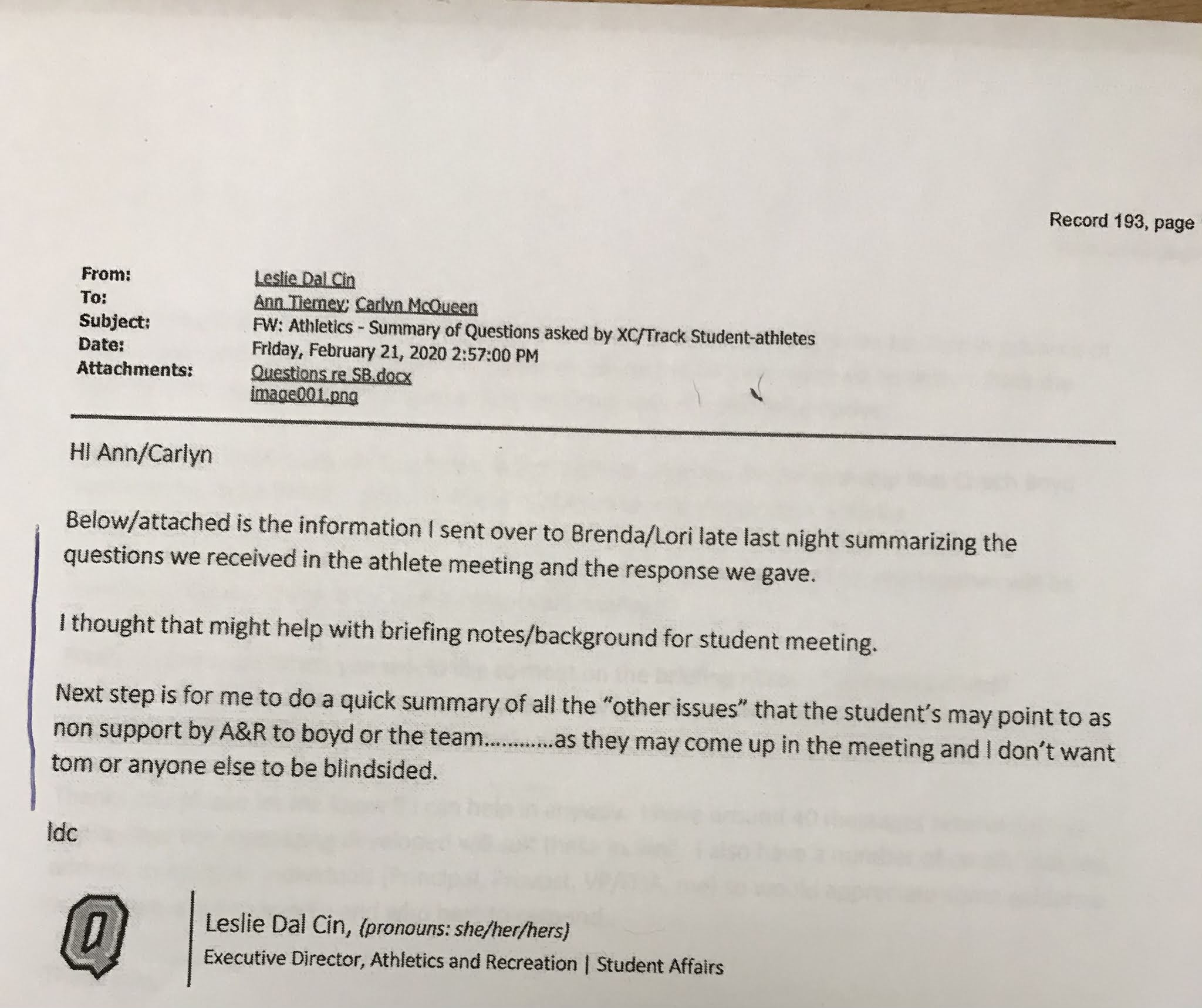

The information (pictured below) offered by Dal Cin to help prep Tom Harris and others to meet with XC/Track athletes-- including so-called "general background" on me and my relationship to Athletics admin, and canned answers to possible athlete questions-- is extremely important and revealing for a number of reasons. And it is important to bear in mind that this document was prepared no later than Feb 21, which is before the above mentioned shift in Queen's narrative about my firing-- i.e. from "objectionable public commentaries" to Harris' and Principal Dean's alledged years-long "berating, abusing, and bullying student athletes".
In the first of her "background" points below, Dal Cin allows that I am a "very good technical coach", but suggests that I "have difficulty working inside formal infrastructure", which results in "(my) team operating outside of existing protocols". Bear in mind that at this point I have be been Head Coach of XC/Track for 10 years. If any of this were true and had been a serious problem for the operation of my program, it would surely have been addressed before this point, and in some other manner. But what Dal Cin fails to mention with regard to the challenge I faced in operating within the "infrastructure" of Queen's Athletics is that I was never fully included in this infrastruture to begin with. In spite of running a program that was at the time of my firing unquestionably the most nationally successful at Queen's over the previous 10 years, I remained the ONLY Varsity Team Coach (out of 13) working on part-time contract. There were several fully contracted ASSISTANT coaches ahead of me. I was also denied a permanent office during my first 9 years(!) as a Queen's coach. No serious explanation was ever offered for this second class treatment of such a successful program and coach. They simply counted on my committment to the athletes I recruited, and on my passion for the sport, to keep me coming back year after year. And while I should by all rights feel like a fool for having done this, I don't.
The remaining four "background" points listed amount to an elaborate insult to the intelligence of members of my former team.
The poor treatment of the XC/Track program was the stuff of legend among team members, past and present. And, of course, it had been the subject of private discussions within the program, including the coaching staff. Members of the 2019 team finally took the initiative to address administrative staff about long outstanding issues after High Performance Director Sean Scott had pointedly ignored the program for several months, including walking by in silence while the women's team was being photographed with its recently won OUA trophy, and "forgetting" to include my OUA Women's Coach of the Year recognition in the yearly university athletics awards ceremony-- a "mistake" that forced Leslie Dal Cin to issue a written apology on behalf of the entire athletics staff. Scott's behaviour was his way of responding to an argument I had had with him in September, whose details are too trivial to recount.
As for the suggestion that my feelings towards Guelph and Dave Scott-Thomas somehow induced an irrational hatred of the university and program in my athletes, Guelph's and Dave Scott-Thomas' reputation among varsity athletes were well established before the Globe's revelations (as I explain above). While the story of the alledged sexual exploitation of a young Megan Brown would have come as a shock to many younger athletes, the suggestion that the program had been abusive towards certain athletes within it would not have been. Bear in mind that many athletes in my program at Queen's had been recruited to run for Guelph and had, obviously, declined. In at least a few cases this was because of the poor reputation of the Guelph program where athlete development and treatment was concerned.
This and the rest of what you see below was part and parcel of the disrepect for the intelligence and callous disregard for the experience of members of my former team shown by Queen's admin. They simply could not bring themselves to admit that I had been fired for speech acts, so they chose to insult, stall, and eventually completely ignore their own student athletes' legitimate concerns-- and all they while hiding behind a professed deep concern for student athlete "victims" elsewhere
And if Queen's had actually had a credible, principled reason for having fired me, one would think that this would have been the moment in which to offer it. In its first meeting with team members, Queen's suggested that it could not divulge the alledged deeper reasons behind my emergency-like dismissal. But below we see that there are still NO plans to supply this information to them at the planned-for meeting with Provost Harris. Instead, administrators are being warned that, in the continued absense of this information, students may begin to make their own inferences! Athlete reports about the eventual meeting with Provost Harris suggest that this script was followed to the letter. They were once again told they could not know the full reason behind my firing (that it was "an HR issue"). To this day, they have never been offered this information. And from the time of that meeting until the present, the tone of all messages to athletes from Queen's Athletics-- a tiny number over a period of many months-- was one of having "moved on".


Finally, the one concrete support repeatedly offered by Queen's admin to XC/Track athletes to help them deal with their confusion and stress was access to mental health counselling. Of course, it would never acknowledge its own role in unnecessarily causing this stress and confusion-- i.e. by refusing to tell the truth. But it was another thing entirely when it failed to deliver on even this small token of concern.
Below is an email exchange between Leslie Dal Cin and (probably) a more senior staff member. In the top message, the senior staff member expresses extreme disappointment ("very, very, disappointed") over the fact that a member of the XC/Track team who had been told by Queen's Athletics admin that the university's Student Wellness Services (SWS) would be prepared for him or anyone else from the team, should they require mental health couselling to deal with difficulties created by my firing, had actually been told by SWS upon arrival on Monday, Feb 24 that "they were not aware of any incident with the XC team". And you can see that, indeed, Dal Cin had explicitly promised in a message dated Saturday Feb 22 that SWS "was also aware" of XC/Track athletes' potential need for counselling support. Feb 22 was a full four days after my dismissal and Queen's still had not put into place the mental health supports they promised athletes would be there when they met first with them to break the news of my dismissal.

The final question to which these emails supply a clear answer concerns the "years of warnings" Queen's claims I had been given about my "social media commentaries". And this allegation was, after all, Queen's final redoubt in it's PR campaign. It's what enabled them to plant the seed in the minds of casual observers within the larger Queen's community-- observers who might be reconsidering their support of the university, financial and otherwise-- that there was perhaps "more to the story", without Queen's actually having to ever substantiate it. Queen's wanted to position itself such that, to believe that I was the victim of silencing, one had to believe that blandly respectable administrators at a prestigious old university were capable of whole-cloth fabrication. They wanted people to believe that "there must be more to it"-- "more" that is, of an ugly, private nature-- simply because they were insinuating it (but Queen's also must have known that people needed there to be more, because the public details were simply not enough to justify what they had done).
And, of course, university administrators are for the most part unwilling and unable to simply invent stories about fired employees. It's simply not worth the risk of exposure by parties to the facts, and rarely necessary in any case. But they are, I was to learn, more than willing and able to distort and embellish (no doubt with the support and imprimateur of their legal counsel) a set of facts when the situation demands.
From a confidential source, I was to learn that, if pressed, Queen's was prepared to claim that I was officially warned about my "social media commentaries" on two occasions between 2015 and 2017-- one that I had to strain to recall, because it was so trivial, and the other that I recalled well, because the situation surrounding it was so unique and strange. And, as the emails below clearly show, neither was for anything like what Queen's wanted people to envision; neither had anything remotely to do with "bulling, berating, and shaming" anyone, let alone vulnerable undergraduates, and both were in response to private complaints by lone individuals that could easily have been ignored-- much more easily, in fact, than the dozens of complaints Queen's ignored about my firing. One of the two complaints was an anonymous one from a notorious and psychologically unstable internet troll who would go on to spam hundreds of email addresses over a period of 5 years with unhinged attacks on me. This person would ultimately reveal himself in a congratulatory message to Queen's for having fired me. This message is also pictured below. I would invite you to consider the similarity in diction and tone to the one pictured above, the one that so bouyed the spirits of Leslie Dal Cin and Tom Harris mid-struggle.
The first message-- cause for the first so-called "warning"-- is clearly from an athletics administrator from somewhere in the Atlantic provinces. It includes text copied from Trackie.ca, the context of which was one of the many "race prediction" discussion threads that are the lifeblood of running fan sites. The message boards of sites like Trackie.ca and Letsrun.com include literally hundreds of such threads, and the owners of them frequently turn them into formal "prediction contexts" of various sorts, replete with prizes (sometimes quite valuable, in the case of Letsrun.com). Fans of all types participate in both these discussions and in the annual "prediction contests", usually anonymously but sometimes under their own names. And the content of discussions is usually very arcane and sometimes heated comparisons of the relative strengths of the top teams and individual competitors in question. In Canada, whose sport community is a tiny fraction the size of that of the US, spread across a vast geographical mass, there is frequently a regional bias in these discussions. And, because university sport in Canada is a much smaller deal than in the US-- particularly in sports like cross country and track-- the stakes are understood to be relatively low. I nevertheless love these discussions, because they reinforce a sense of community within our sport-- warts and all-- and because they are frequently vectors for the spread of knowledge and lore from one generation to the next.
Note that the sender him/herself suggests that the subject matter is "no big deal", because, he/she says, it likely "doesn't reach a wide audience" (in other words, they seem to recognize the discussion for exactly what it is-- sub-cultural banter among serious afficionados). They neverthelss DO feel the need to contact Queen's about it (yet do not avail themselves of Trackie.ca's "report post" tool-- the easiest and most appropriate remedy for offense-takers). Queen's contacts me for a meeting and asks me to write an apology to the sender (whose name I am never told). Though, at the meeting, I try to explain something about the contex of the post, and suggest that the concern is misplaced, I agree to write a brief apology and to ask Trackie to remove the post (utimately, the entire thread is removed, for reasons known only to Trackie). Five years later, I would need to be reminded that it had ever happened. And I leave the reader here to wonder at what sort of world a person who would proceed to contact someone's employer over something so trivial could actually inhabit? And the short version of the answer would be: the world of university administrators, who, as the emails above suggest, seem to mix personal relationships with business without a second thought. This administrator complained to their counterpart at Queen's seemingly without regard for the triviality of the complaint, simply because they knew they could.


As I said, the second "warning" was memorable, due to the strangeness of the circumstances that lead to it. But the story behind it begins with another discussion on Trackie.ca-- one that blended with several others on Letsrun.com-- and was, indeed, a subject of very great public interest at the time. The discussion centred around the controversial South African intersex athlete Castor Semenya and whether her participation on the women's division of the World Championships and Olympic Games should be permitted (athletes with her condition were eventually banned from competition at distances 400m to 1500m). A registered but anonymous contributor was eventually banned entirely from participation on the message board for blatantly racist, mysogynistic, and homophobic comments about Semenya (this person was believed by many to be Asad Raza, a former high school track athlete from Brampton, Ontario, now relocated to Michigan and working as General Practitioner). Since I had defended Semenya's right to compete as a women, and had challenged this person's dehumanizing comments about her, he came to the conclusion that I had been at fault for his banning. He then proceeded to engage in what would turn out to be an unhinged, mult-year campaign of public and private harassment, one that frequently included graphic threats of violence, sexual and otherwise, against me and members of my family. He sent these messages and posted on Letsrun.com under a variety of false names. In the public attacks, he preferred to use women's names, and claimed to represent a group of people alleging that I had attacked or offended them online. He directed much of this campaign squarely at Queen's, with the possible hope that they would take his ravings seriously, but with the more likely aim of having them blame ME for his behaviour (which Queen's subsequently did). Hundreds of people within the Canadian Athletics community, from high school coaches and junior club presidents to the CEO of Athletics Canada, would receive his emails,
Over a period of three years, he would dispatch several waves of psychologically unbalanced email complaints to Queen's email addresses, including those of top administrators. After the first wave (in June of 2017) I was summoned to Director Dal Cin's office with the demand that I explain what was happening. I told her about the Trackie discussion and about Raza's having been banned for his disgraceful attacks on Semenya, and about the private messages I had been recieving. I also told her that I had a pretty good idea of who was behind the messages, having had civil dealings with him about other matters many years before (as a younger man, he hosted a web archive of provincial high school track and field results and had once asked me for help with it), Dal Cin's response was simply to ask that I stop "communicating" with Raza (with whom I had NOT yet communicated outside of the Trackie discussion, and even then only in the form of his anonymous avatar). When I asked what Queen's was able to do to support me, she offered nothing. Years later, after Raza's third or fourth email barrage, and after they had finally recognized that I was actually the victim in all of this and not the precipitant, Queen's still offered nothing, even claiming that blocking him from emailing Queen's addresses was impossible.
A couple of weeks after this meeting with Dal Cin in 2017, and in response to subsequent barrage of sexually violent threats sent to my private email address from Raza's fake address, I broke down and sent him a reply, saying that I knew who he was, that he should stop, and that he might also consider coming to grips with the psycho-sexual difficulties he was clearly experiencing, as evidenced by both his attacks on Castor Semenya and his violent, homophobic threats against me. His repsonse was to forward both his own violently threatening messages and my reply to him (but with my reply strategically doctored in places to make it sound as though I was threatening and insulting him!) to the same set of admin email addresses as his first attack. Queen's response was to once again blame me for the whole business and to formally threaten to fire me if I had any more contact with Raza. As I mentioned, after years of similar attacks by Raza, they eventually recognized that he did not require any response from me to provoke him; that he was completely unhinged psychologically, and would continue to do what he was doing regardless of anything I said or did. It was at this time that I directly requested that Dal Cin remove the letter of warning (pictured below) from my personnel file-- or at least amend it. I was promised that it would not be used against me in any way. And, in fact, in spite of the contents of this warning, and consistent with this request, the record amply shows I continued to be active on social media of all types without even the mention of disciplinary action from Queen's for three years-- right up until the moment of my firing for my comments on the Guelph scandal.
Pictured below is the congratulatory message Raza sent to Queen's after my firing (dated Feb 28). In it, Raza confirms that he has indeed been the one sending the messages of "complaint" against me for three years-- and after taking such pains to send all of these dozens of unhinged rants from encrypted accounts registered to fake names! I include just enough of the original "complaint" to give you an idea of who we had been dealing with. It actually goes on for several more pages, and includes a distribution list of some 200 addresses. As an aside, note the credulity of the forwarder of the message, who sees Raza's ravings as a genuine message of "support" for the decision to fire me!
Below that is, again, the official letter of warning I recieved from Queen's following my email reply to Raza in 2017. Note that it includes a reference to the meeting wherein it was requested that I apologize to the administrator from the East Coast


Epilogue: Answers to Questions You May Have:
1. Why bother with all this?
Simple: My issue with Queen's was not necessarily that they fired me. In the end, they owned the program I built. What I objected to-- to put it as mildly as possible-- was their attempt to undermine my reputation among casual observers of the story (those who knew me would not have bought their line, even if they did not share any of my views)-- which it did simply in order to avoid the charge of having violated my free speech protections and to stem the financial and reputational losses associated with having appeared to have silenced an employee on a matter of public interest. As everything I have shown and said so far should finally make clear, whatever Queen's thought of me, there were lies and distortions at the very centre of their publicly stated reasons for my dismissal. If Queen's had had the courage to openly state the actual reason it was choosing to fire me-- that it was merely responding to complaints and requests from administrators at the University of Guelph that I be immediately stopped from commenting on their burgeoning scandal-- I certainly would not have respected them; but, I would have had little more to say about the matter. What would there have been to say that was not already obvious? If they had been willing to admit that their ballyhooed commitment to free speech by Queen's community members extends only as far as the tolerance of their colleagues at other universities, then who would I have been to complain?
2.If you, your program, and your athletes were treated so shoddily by Queen's admin for so many years, why did you ever want to go back there? Why did you support your own reinstatement?
As I said at the time, I was willing to go back there only because the program was at a high water mark in terms of its competitive success and-- more importantly-- its internal culture. In other words, we were beginning to show that long term success based on a model diametrically opposite from that of Guelph was not only possible but potentially more enduring. What disappoints me most about having been fired is the realization that Queen's had no understanding or appreciation of what it had-- of what I, Brant, and the remarkable student leaders had built over the years-- and was therefore willing to throw it away in order to satisfy a tiny number of my detractors, whose complaints they could easily have ignored, and whose grievances would have been forgotten in a matter of days or weeks in any case. (And, again, they amply demonstrated their ability to brazen-out complaints when they made up their minds.) They had never made any effort to understand how I operated as a coach and program builder (which is why they never fully contracted me); they did not value our success as a program on any level; and they thus viewed any time spent thinking about or attending to me or my progam as more or less a distraction from more important matters. We were to be seen and not heard, producing excellence at the lowest possible cost in terms of dollars and time. It was the furthest thing from their minds, therefore, to actually consider defending me against outside criticism, or weigh my contribution to Queen's Athletics against any outside criticisms of my style (which were always petty and overblown in any case). But, as I said the day after I was fired, if this was the offer Queen's was determined make-- the job in return for their right to police my legitimate speech regarding matters of interest in my sport-- I was always going to cross it at some point.Finally, in the end, the team's efforts to reinstate me were a valuable lesson for them in the folly of trusting those in positions of power and authority to always do the right thing-- one they will likely never forget. Though I never expected they would succeed, supporting them was important to me at that time.
3. Didn't you regret your participation in the infamous Facebook discussion? Or, don't you wish you had waited longer to raise the questions you did (i.e. about appropriate institutional sanctions against Guelph?)?
No. And, in fact, I regret my posing of those questions to that group of Guelph alums less and less with each passing day. Their near total silence since that day-- their unwillingness to publicly criticise Guelph or the program leadership, or, indeed, to publicly comment on the story in any way (apart from Reid Coolsaet's attempt to account for himself in his blog, about which the less said the better)-- meant that this Facebook discussion would surely have been the one and only chance anyone would get to pose critical questions directly to the most important members of Guelph's program alumni community. Even the recent publication of a major "policy review"-- ostensibly an investigation into Guelph admin's failure to stop Scott-Thomas' and his abusive behaviour sooner-- provoked little or no response from within that community. Likewise a public assertion (on Facebook) by a recent former team member (Kelsey Serviss) that Guelph admin ignored her complaints about Scott-Thomas, and that it no longer had access to years of athlete program evaluation forms that might have revealed similar complaints of abuse. As of this writing, her Facebook post has generated just 4 comments, none from former team mates, and only 33 "likes", with only a tiny handful coming from members of the larger Guelph XC/Track alumni community. This suggests either a fear of speaking out, a belief that doing so is somehow inappropriate, or perhaps that the entire affair (excluding, possibly, the sexual exploitation of Megan Brown) was overblown from the beginning. Anyone of these responses would be, of course, unacceptable. These people have a duty to demand real answers and real accountability for what was allowed to happen within their program for so many years.
Broader Lessons Learned:
1. Speaking out publicly about abuse within the university sports system is the ONLY way real redress and real change will be forthcoming. University administrations will often respond privately to instances of abuse, but only by closing the policy barn doors that allowed the horses out in the first place (and/or with internal promotional campaigns, such as Queen's "We Are All Gaels" initiative in the wake of allegations of predatory homophobic bahavior within the football program); if at all possible, they will avoid making any kind of public example of failure, and they will always balance their own instituional interests against the rights and needs of victims, leaving the latter unsatisfied and the potential for further abuse insufficiently addressed. That speaking out publicly can work is vividly attested to by the blind panic of administrators at Guelph and Queen's at the prospect of open commentary on their actions or inactions . (And the appearance of student-athlete's voices in public fora seems to particularly terrify them.) They will apparently go to great links to prevent their business from breaking into the public domain, via either form of media-- news or social-- because it's only then that they will be forced to truly act. It is only after the Scott-Thomas scandal became national news that Guelph took action against him. As difficult as it would have been, had Guelph student athletes spoken out sooner about their experiences in that program-- not necessarily while in it, but soon after leaving, as members of the Wesleyan women's XC team did about their experiences of abusive coaching practices there-- then there is little question that the hand of Guelph would have been forced years before it finally was.
2. If you are a coach in this sport, at either the university or club level, do not expect real courage, collegiality, or professional solidarity from within your community or from your professional associations, should you decide to speak out publicly about something you consider to be a matter of principle. And this is not a question of expecting agreement from these quarters; it is a matter of expecting support for your fundamental right to raise your voice in expression of a sincerely-held view or opinion. The lack of public response by Canadian coaches to the Guelph scandal, including the utter absence of demands for greater insitutional accountability, was appalling. Many of us had worked in close proximity to Dave Scott-Thomas and knew well how he operated. Many of us had even heard the rumours about his abuse of Megan Brown. Yet, where were our voices when the moment came to demand accountability and real redress from the University of Guelph, the OUA, U-Sports, and Athletics Canada? Where were the voices of our professional associations? Last year at this time, there was great fear that the entire business would eventually be swept under the rug or flushed down the memory hole-- and so it more or less has, and we did nothing to stop it.
In my own case, it was depressing but not surprising that I recieved far more support from the professional academic community-- and from complete strangers, in many cases-- than from those with whom I had worked most closely for more than 10 years. In fact, I received no support, public OR priviate, AT ALL from my professional collegues in the university ranks (apart from that of my former assistant coach Brant Stachel) in wake of my dismissal. And, again, this is not a matter of expecting agreement with anything I had said. Others, including a few whose personal politics were completely at odds with my own, could clearly see that this was a matter of someone's right to speak and stand on principle, not a question of agreement with any particular statement. And yet, some of those who knew me best professionally; knew about my program; and knew about my history of speaking out on matters of principled importance to me, could not bring themselves to offer even a token message of support, public OR private. Not one. One even saw my dismissal merely as an opportunity to advance his own coaching career-- and after opining in a public forum that Queen's had been within its right to fire me, free speech protections notwithstanding. Another accepted an invitation from the people who fired me to sit on the hiring panel that would select my replacement. Even if they were subject to same threats about speaking out that I was, this withholding of basic professional solidarity is craven beyond belief and induces in me a shame that I was ever part of such a community of cowards and abject followers.
As for the institions that regulate and administer our sport in this province and country, they are not fit for purpose. It's one thing to have allowed a character like Dave Scott-Thomas to thrive and prosper within the system, helping, as he did, to advance the careers of a handful of those with whom he had worked most closely along the way; it is another thing entirely to act as though simply having gotten rid of him represents sufficient accountability and redress. But, now, a year later, that ship appears to have long since sailed.
posted by Steve at
19:42
2 Comments

